

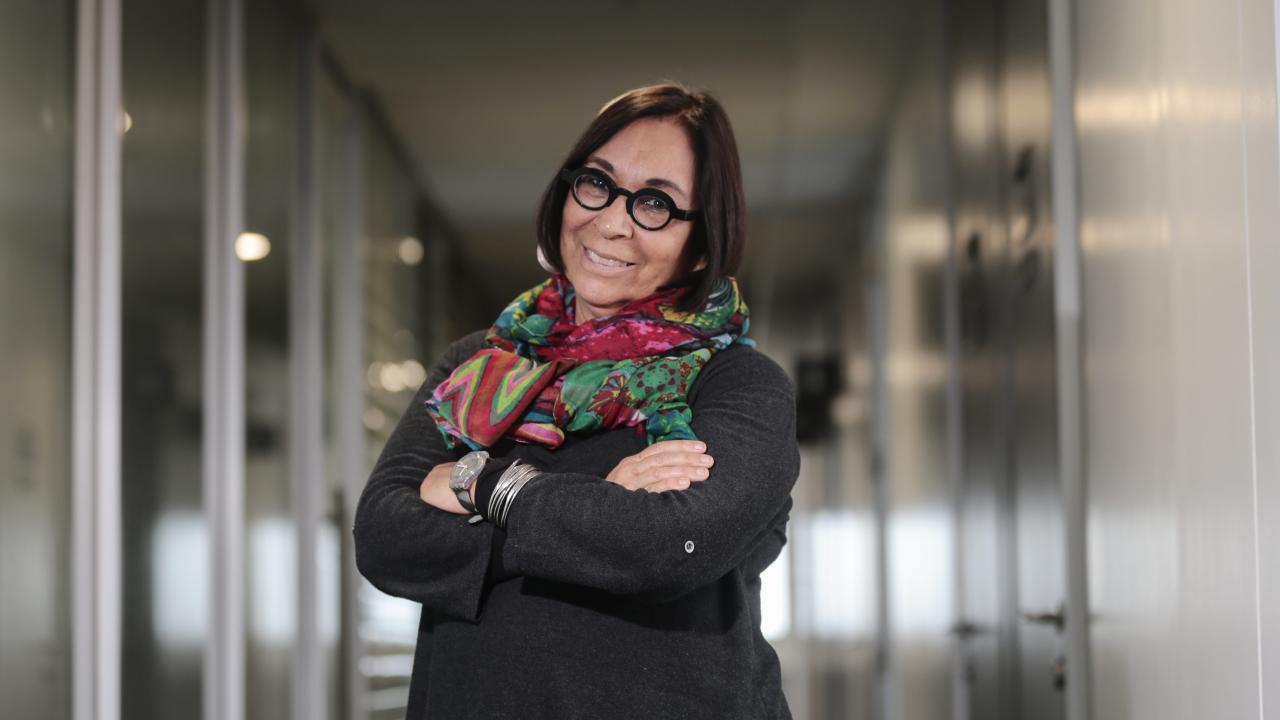
The research of anthropologist Marisol de la Cadena pushes the limits of thought. How does the scholarly vocabulary of anthropology shape and restrict how we think and, further, what we can think? How does it inform how we think about ourselves, the world and the other beings we share the planet with?
Such questions inform de la Cadena’s practice of “an anthropology aware of our ways of knowing.” Her reflections start with anthropology as a colonial discipline.
“Implicit in this assertion is the need, or rather urgency, to reflect on the colonizing tool of the discipline: the practices that made the modern world and canceled modes of worlding those practices deemed inferior, and ultimately, impossible,” said de la Cadena, a professor who holds appointments in both the Department of Anthropology and the Department of Science and Technology Studies.
“Modern thought became and continues to be a colonizing tool,” she added.
That reflection, that “anthropology aware of our ways of knowing,” implies a profound transformation that while extremely difficult is necessary, de la Cadena said. It is also contested, even from within the discipline.
"My practice of anthropology encourages possibilities towards the decolonization of modern thought so we can untether modern sciences from the world-making supremacy that the coloniality of modern knowledge instilled in them," said de la Cadena. "Historically instilled, it can be historically distilled. This would allow the sciences to create without superiority, starting within our discipline, at its very origins, by undoing the relation of epistemic hierarchy produced and sustained by the image of the anthropologist as the ‘knower of their beliefs.’"
For her innovative research in Indigenous studies and on the politics of knowledge, de la Cadena was recently elected as a fellow of the American Academy of Arts and Sciences, one of the nation’s oldest and most prestigious honorary societies.
“Professor de la Cadena’s work explores how different communities understand life, especially when those ways of knowing do not fit neatly with Western academic or political frameworks,” University of California stated in their announcement article about the 2026 awardees.
“This is an extraordinary recognition,” de la Cadena said, “because I’m writing about things that are not easy to think and are usually thought as impossible.”
What ‘Earth beings’ reveal about anthropology and language
De la Cadena credited Mariano and Nazario Turpo, a father and son belonging to the Runakuna or Quechua people, with transforming her approach to thought and language. Conversations with them spanning 10 years led to her writing Earth-Beings: Ecologies of Practice Across Andean Worlds (Duke University Press, 2015).
“With them, I learned a different way of thinking, and I learned what thought could do if we explore what we think and how we think,” de la Cadena said. “The how and what are completely linked.”
“I learned, for example,” she added, “that a mountain is not only a mountain, it could be an ‘Earth being.’”
“Not only” became a refrain for de la Cadena.
Her current research project “Making Cow,” analyzes the conceptual and political differences between ‘cows’ and ‘cattle’
“If we conceptualize them as a multispecies relation and follow how they are made we can observe that ‘cows’ and ‘cattle’ are not the same relational entity even if the taxonomic animal unit is the same,” de la Cadena said. “The difference starts with the epistemic and economic conception of how the animal conceives biologically. While the reproduction of cattle makes capital, making cow engenders life.”
While cattle proliferate, de la Cadena said, cow is an endangered multispecies and agricultural condition. This impacts regional landscapes, local economy and what we call the environment.
The research is based in Colombia.
How UC Davis anthropology encourages new ways of thinking
It may be no surprise that another refrain of de la Cadena’s, one that she always urges her graduate students to keep in mind, is “think.” People, places, land formations — pretty much everything under the sun — are (or can be) more than the names associated with them. Their meanings and essences can push beyond the limits of thought.
Her graduate students have studied a variety of topics, including the formation of glaciers in Antarctica, the creation of soil in labs, how the dead talk through autopsies, dogs trained to search for landmines and how natural landscapes create national borders, to name a few.
The breadth of topics is a testament to the unique and distinctive nature of the university’s Department of Anthropology.
“Cultural anthropology at UC Davis is a very special anthropology,” de la Cadena said. “It has its own personality, its own vibration; it’s identifiable.”
Media Resources
Media Contacts:
- Karen Nikos-Rose, News and Media Relations, 530-219-5472, kmnikos@ucdavis.edu