
Quick Summary
- A first-person account
Mark Tucker, a UC Davis alum and conservator, visited UC Davis as the Art History department’s guest speaker on “The Challenges of Altered Paintings” in April, explaining how restoration can reveal art in new ways for viewers.
"Are you ever scared of messing up a ‘really old’ piece of art and have you before?” He asked the audience, made up of students, faculty and staff. He told stories of how he found original works layers below the one he first received, to reveal that he found a completely different painting under the “newer” one. So — he illustrated in his talk — sometimes restoration is not ruining the painting, but revealing what the artist intended.
Students in the fields of Art History and Art Studio who attended the talk had an opportunity to learn about a viable career path after graduation. Tucker graduated with a bachelor’s degree in Art Studio from UC Davis, and later earned his master’s degree in Conservation at the State University of New York. Tucker now has more than 33 years of experience in conservation at the Philadelphia Museum of Art.
Through a presentation, Tucker took listeners through five examples of his personal restoration efforts, sharing stories of paintings that needed everything from gentle restoration to those that needed parts of the old painting to be revealed again after being covered up by well-intentioned restoration work.
He shared examples from his conservation career, including evidence for one painting in which an original print featured a skeleton between two figures. A section had been completely removed, it seemed.
In the work, The Last Drop by Judith Leyster, it was theorized, Tucker said, that in order to better market the painting, conservators repainted the background to cover the skeleton.
Tucker explained the scientific approach that they conducted to determine if the skeleton was indeed there. Through radiographic x-ray imaging, the conservation team detected the skeleton that had been covered in previousconservation efforts. Tucker was able to expose the original painting after removing the added layers of paint.
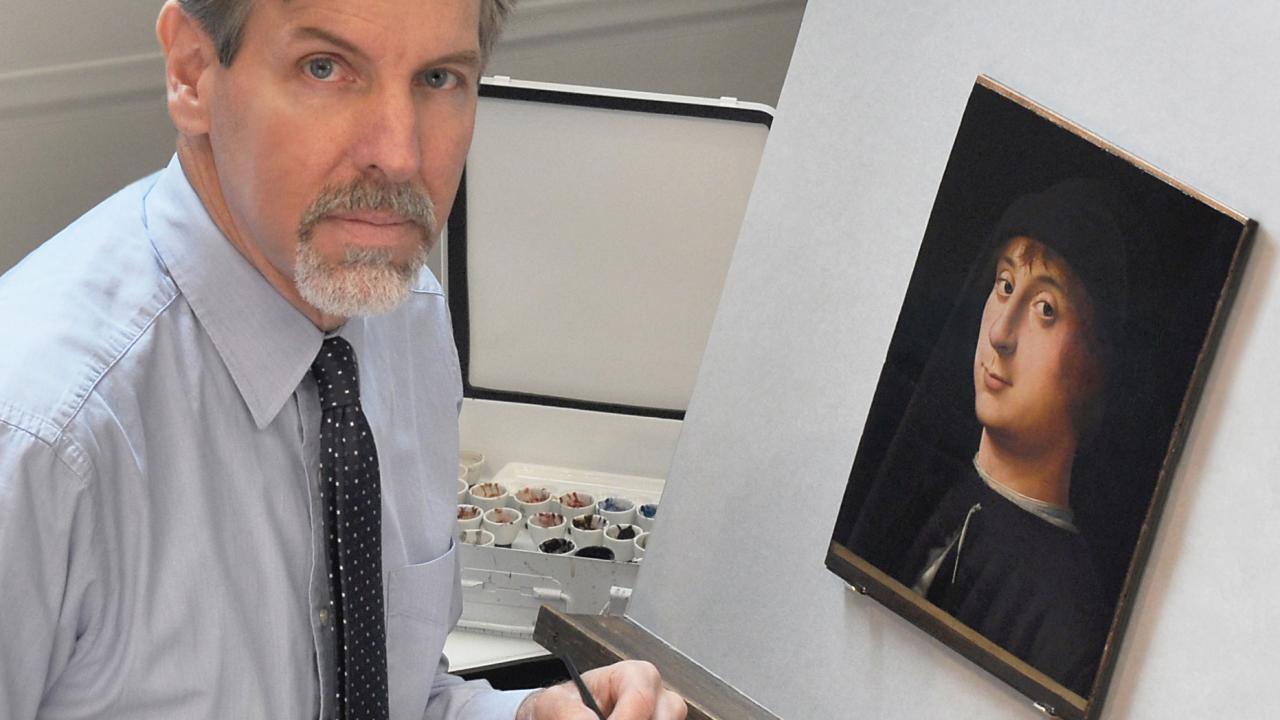
Perhaps the most shocking of the restoration stories he told was of Portrait of a Young Gentleman by Antonello da Messina. As Tucker explained, more than 60% of the original portrait had been removed.
What was once a portrait of a young man against a dark black background became a painting that was stripped down to its underpainting, leaving only the face and part of the clothing on the canvas. The room gasped as Tucker showed the extremity of the damage done to this painting. He said the restoration took 420 hours to complete. Tucker’s approach to the restoration was painting miniscule brush strokes in the areas where the paint was completely lost. This practice allows for a distinction between the original artwork and the restoration completed.
I entered the talk knowing little about the practice of conservation, but I left understanding the career almost completely. I was extremely impressed by the extent of restoration in the examples he shared. This profession combines techniques learned in Art Studio, Art History, and chemistry classes. This mix of interests broadens the spectrum for career paths for multiple disciplines, even those outside of the arts.
Media Resources
Karen Nikos-Rose, Arts Blog Editor, kmnikos@ucdavis.edu