
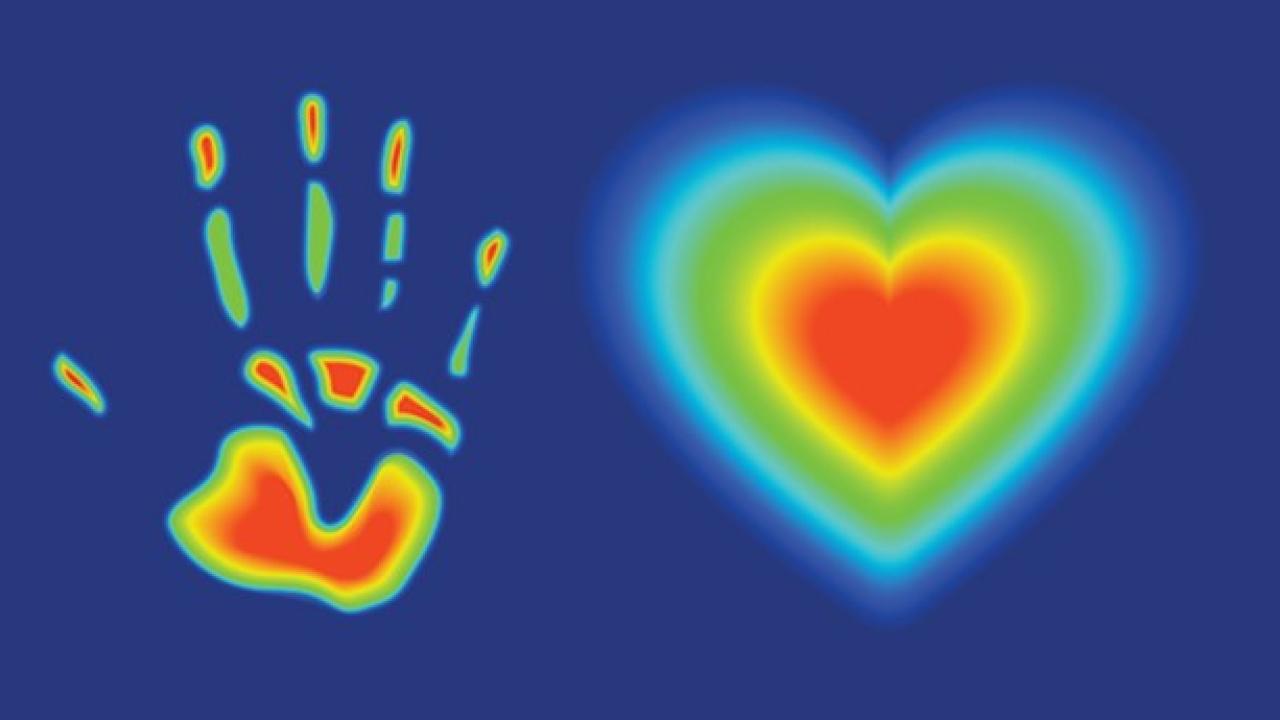
The saying “cold hands, warm heart” is usually meant metaphorically — but new research from UC Davis School of Medicine and collaborating institutions suggests it has a striking biological parallel.
Researchers found that body temperature plays a key role in which tissues are affected by mutations in a gene called TRPM4 which is involved in both inherited heart conditions and rare, but severe, skin diseases. One mutation becomes active only in cooler skin, and another exerts its effects only at the heart’s warmer, core body temperature. Cell type and local chemical signals also play a role.
The findings, published in the Proceedings of the National Academy of Sciences (PNAS), offer a clear explanation for why disease‑causing TRPM4 mutations lead to mutually exclusive conditions.
“This has been a mystery in the field for years,” said Yuhua Tian, first author of the study, and a visiting assistant professor in the Department of Physiology and Membrane Biology. “We now understand that it’s not just the mutation itself that matters, but where in the body the protein is active and under what conditions.”
TRPM4 carries instructions to make a protein that acts as a gate on the surface of cells, allowing positively charged ions to enter the cell and affect its electrical state.
Media Resources
Cold hands, warm heart — Researchers solve medical mystery of why TRPM4 mutations affect skin and heart differently (UC Davis Health)
Heat- and PIP2-dependent TRPM4 activity underlies mutually exclusive human diseases (PNAS)
Lisa Howard is a senior public information officer at UC Davis Health.