

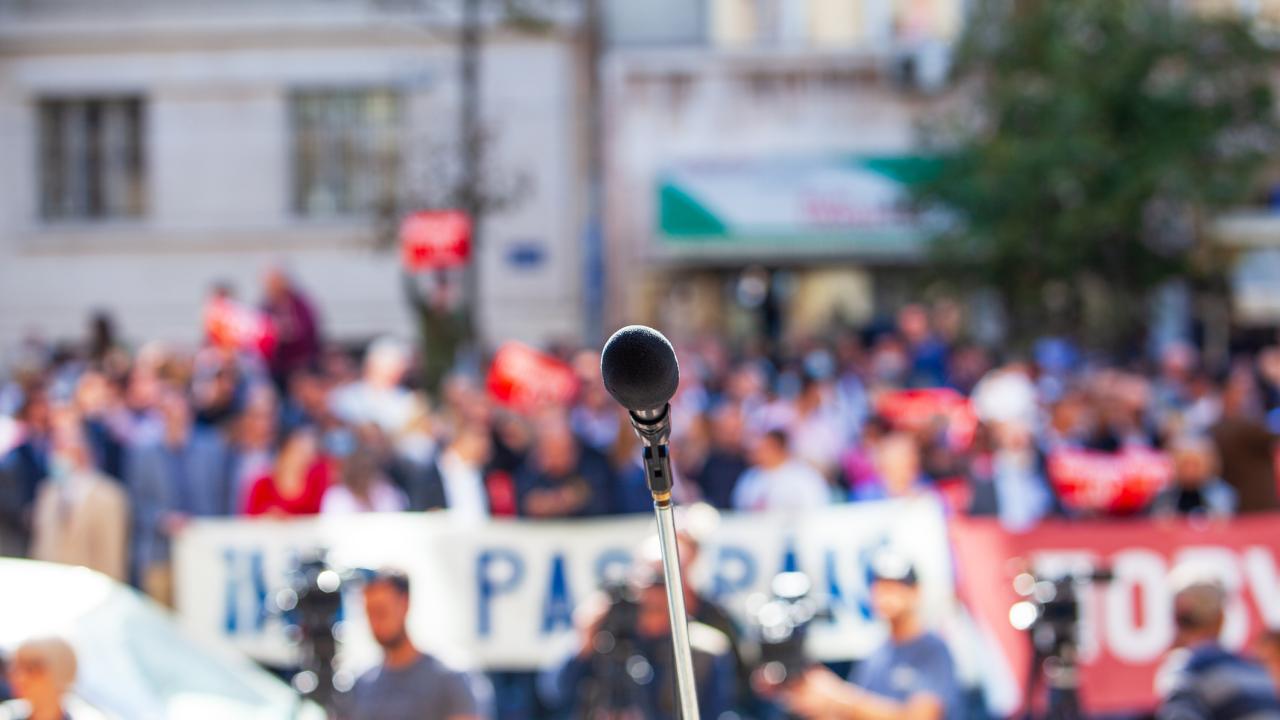
George Floyd’s killing in 2020 by Minneapolis police became a media storm, but the event itself was not, unfortunately, unique.
Every year, many unarmed Black men are killed by police but almost none of those deaths resulted in nearly the same volume of stories in news media that would make up a media storm. Amber Boydstun, a political scientist, wanted to know why.
“There was this shocking video,” she said, “but if you look at the history of unarmed Black men killed by police in the U.S., it’s not like there was something different about the underlying nature of this case.”
George Floyd’s death sparked Boydstun’s investigation into why some events drive an explosion of sustained media coverage and why other events, even very similar ones, don’t. With co-authors Jill R. Laufer, Dallas Card and Noah A. Smith, she published this research in the new open-access book on media storms, Catching Fire in the News (Cambridge, 2026).
“If you want to understand media and politics today, you cannot understand it without understanding media storms and where they come from,” said Boydstun.
The three ingredients behind media storms
A media storm is a sudden, high-volume of news media coverage that lasts for at least one week. Coverage in a media storm is so high that even people who don’t pay attention to the news have heard about the event. Until now, what drives a media storm hasn’t been clear.
Boydstun and her colleagues’ research found that a media storm is made up of three parts:
- Heat: a dramatic event or discovery
- Fuel: The political and cultural landscape, including similar items in recent news and current debates that allow the event to be framed in a resonant way
- Oxygen: the available news agenda space, plus attention the event receives beyond the reporting itself
In their analysis, the researchers identified pairs of similar events, one that produced a media storm and another one that didn’t. Comparing the differences between these events, they identified the three ingredients.
Why Greta Thunberg generated more media coverage than Mari Copeny
Swedish climate activist Greta Thunberg received a weekly peak of 144 news media stories in 2019 while American environmental activist Mari Copeny received a peak of seven in 2016. Both drew attention to urgent climate-related crises unfolding in real time. Why did Thunberg generate a media storm while Copeny didn’t?
Heat: Thunberg comes from a wealthy, mostly white country and as a teenager introduced an unconventional, defiant approach that included criticizing world leaders on the international stage. Copeny, whose message to President Obama led to $170 million in federal funds to address the water crisis in Flint, Michigan when she was only eight years old, was Black and had no viral images or videos of her activism.
Fuel: Thunberg benefitted from a time when young people were increasingly politically active following the March for Our Lives movement driven by survivors of the Parkland High School shooting. Thunberg’s efforts were also amplified by a lack of strong climate leadership at a time of prominent and worsening natural disasters. Copeny’s activism began earlier, before young people joined in large numbers. Flint’s water problem was also a local, rather than a global, one.
Oxygen: World leaders amplified Thunberg’s story and message. Her social media presence reached millions of followers. While President Obama responded to Copeny’s letter and visited Flint in response, the focus remained on the water crisis itself.
For all three ingredients for a media storm—heat, fuel and oxygen—Thunberg scored very high while Copeny scored medium to low. An appendix online includes 13 comparisons between events that did and didn’t generate media storms.
Why media storms matter for politics and democracy
Boydstun and her co-authors turned in their manuscript for publication more than a year ago, and in that time the media landscape has changed dramatically. The biggest difference is a lack of oxygen for any story.
For example, the killings of Renee Good and Alex Pretti in Minneapolis by federal agents generated a media storm but news outlets quickly moved on. News media have covered event after event since January 2025, including federal immigration agent violence, tariffs, war in the middle east, landmark Supreme Court cases and many, many other events that affect everyone.
At the same time, media storms still can create change in society.
“Media storms are impactful, sometimes in positive ways for democracy because they force policy makers to act very quickly.”
The media storm surrounding George Floyd’s death provoked a national dialogue on police violence. Across the country, 29 states enacted at least some policing reforms.
The appendix to the book includes classroom teaching resources that can deepen student’s understanding of media storms. The book itself is open-access and free to download.
“Media storms are really important,” said Boydstun, “but before the book we didn't know what made them happen.”
Media Resources
Alex Russell, College of Letters and Science, parussell@ucdavis.edu