
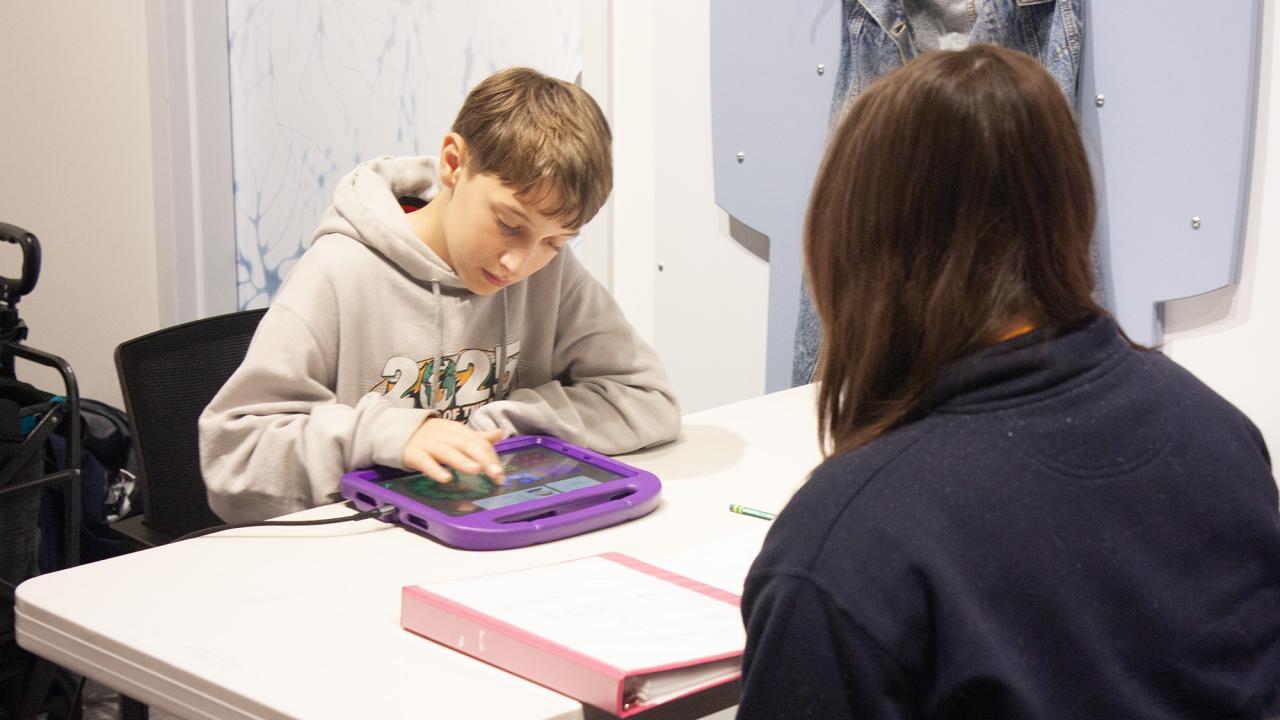
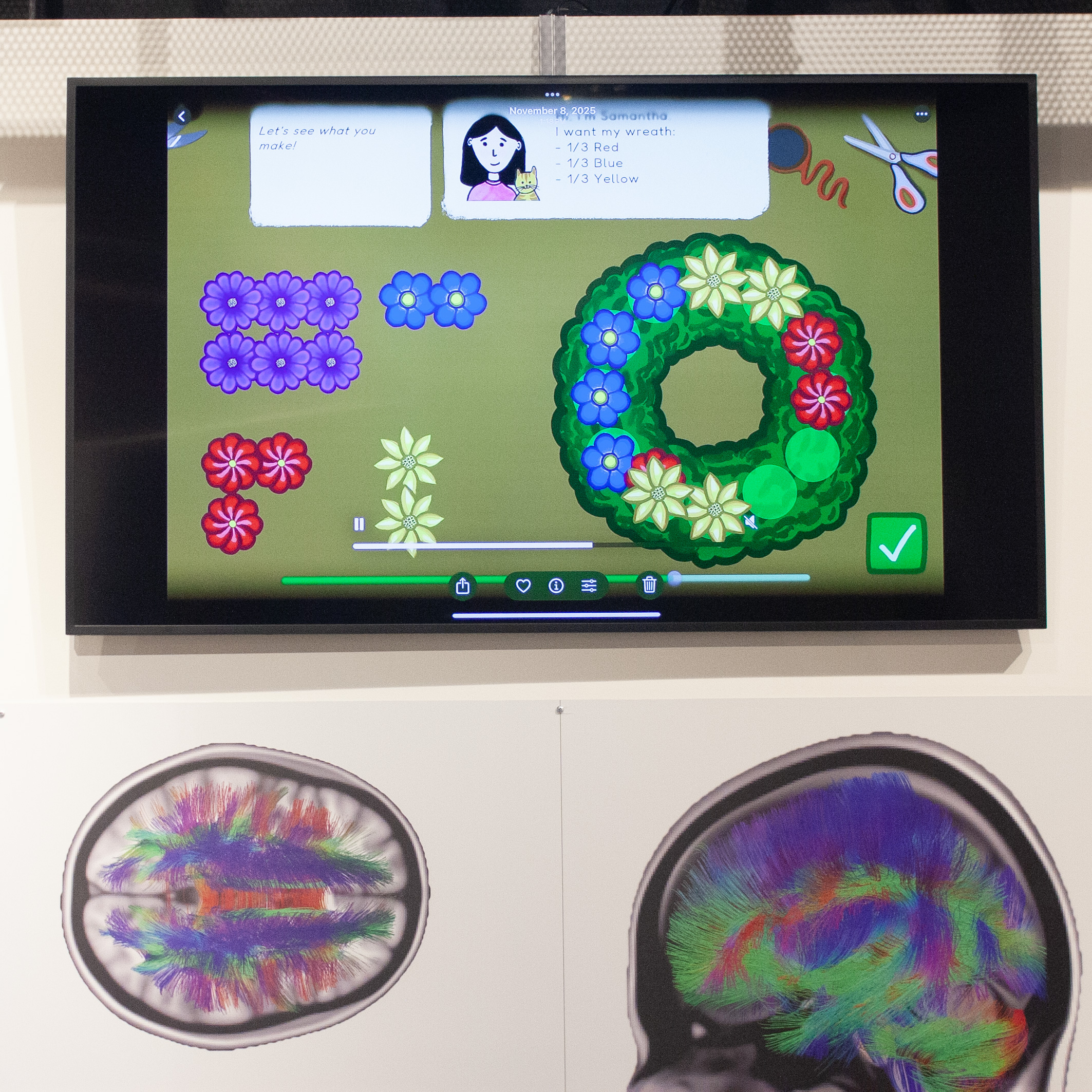
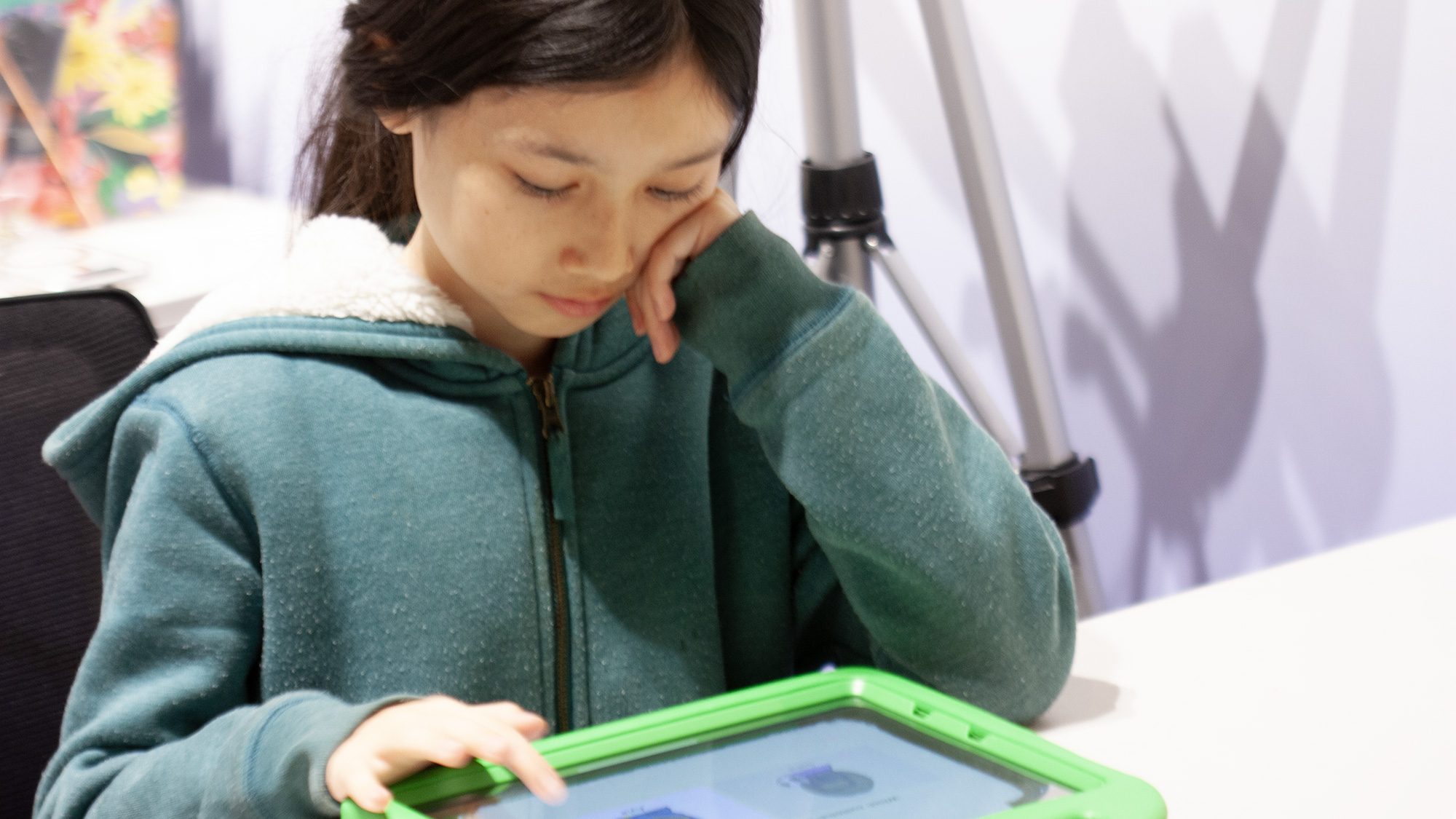
In a game played on the tablet screen, Sasha, a virtual flower shop customer with a bird on her shoulder, asks for a wreath divided equally into thirds between purple, blue and red blooms.
The digital graphics look hand painted. The four sets of six flowers are all different shapes. The player drags a flower across the screen to fill one of the 12 slots on the wreath and it drops into place with a satisfying click.
Sasha is happy with her finished wreath. She says, “Flawless — every flower fits beautifully. I love it.”
The last step is to choose a bow.
On Presidents Day weekend, children at the SMUD Museum of Science and Curiosity, or MOSAC, in Sacramento played Wreathies, a game created by graduate and undergraduate students in the Department of Communication’s UC Davis Media Lab.
The game is part of a scientific study to test whether kids between 8 and 12 years old prefer to have choices in their learning.
“Having choices is something humans need, and we often don’t give them to children,” said Allyson Snyder, the project’s principal investigator and a Ph.D. candidate in communication.
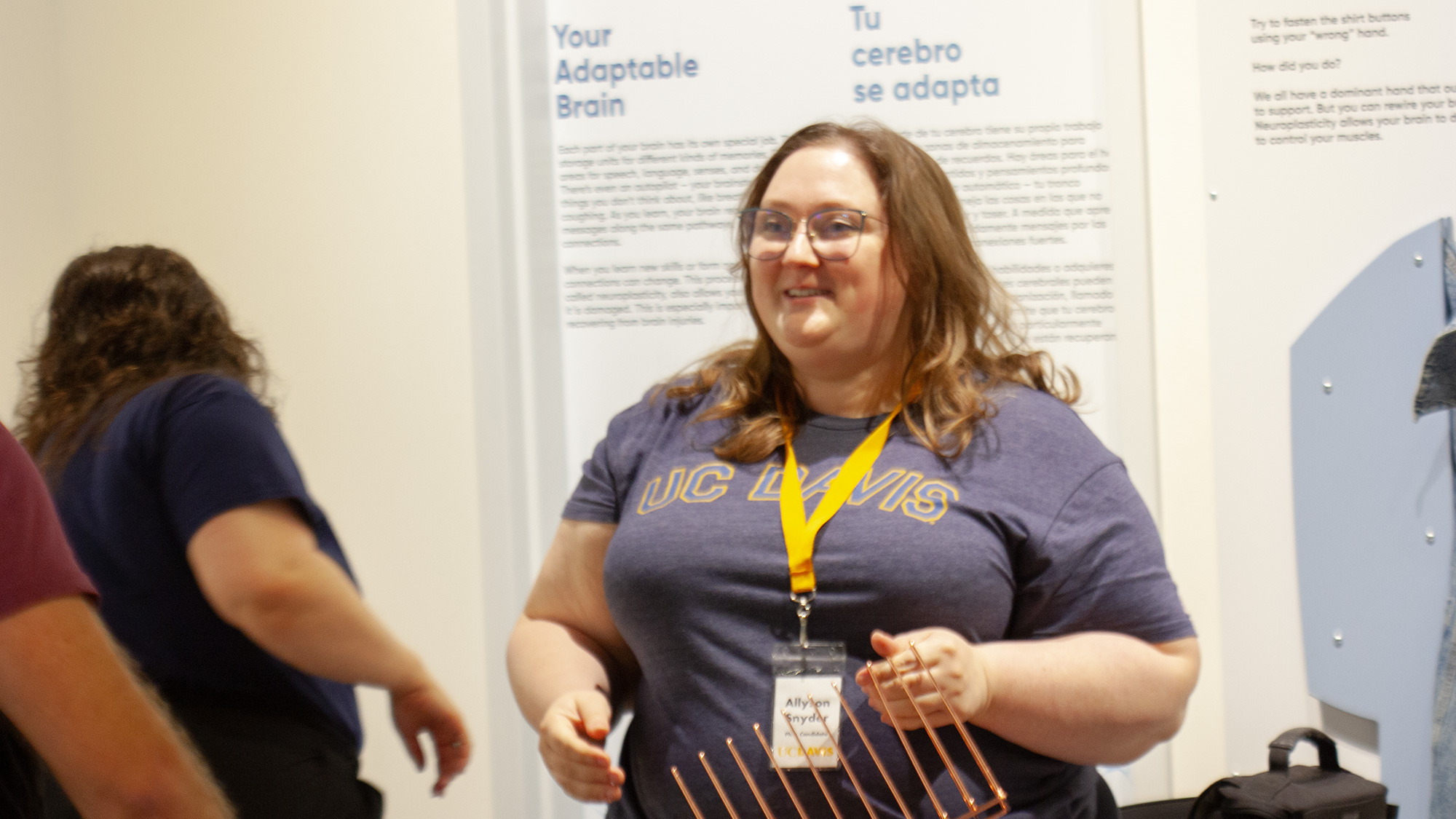
A game of fractions and flowers
A tablet-based app, Wreathies is the first app the research team built from scratch. While Snyder knew exactly what she wanted to test, she turned the game development itself over to her undergraduate research assistants.
Katherine Ong, a double-major in cognitive science and design, and Alexandra Litinskiy, who recently graduated with a major in design, began thinking about a game built around themes of growth and creativity. They settled on the idea of a flower shop.
“It took time to come up with a game that would test what Allyson wanted to study,” said Ong.
The team created a game prototype with a whiteboard and magnets and tested it out at a nearby pre-school. Fractions proved a little too advanced for preschoolers, but the team still asked these youngest of scientists for feedback about the game.
“The kids really loved the sound when the magnets stuck to the whiteboard,” said Snyder.
Building an app to test feelings of choice
Ong and Litinskiy incorporated the feedback they received to update their concept. Then Litinskiy began building the game on the Unity game development platform. She also created the game’s look and original art.
Wreathies teaches fractions and collects data for Snyder’s research by giving players varying levels of agency. Testing a sense of agency — the feeling that you can make choices — is like testing any other subjective feeling.
Players might have a choice between two flower shop customers, a boy or a girl with different skin tones and hair styles, as well as a choice between two bows. For some kids, one customer and bow choice are grayed out so they can’t choose.
These choices break up players into two roughly equal experimental groups:
- High agency: children pick customers and bows
- No agency: children cannot pick; one option for both customer and bow is grayed out
Building Wreathies took Litinskiy the whole summer of 2025. It was hard work, and the code was buggy. She incorporated the clicking sound of when the magnets stuck to the physical whiteboard into the app design.
The team tested the first version of the app with the children of professors in the Department of Communication. Kids between 8 and 12 years old were just right.
Real people behind the science
MOSAC is the ideal place to launch Wreathies to the general public. In 2024, Snyder led another study at MOSAC that tested whether children learning to manipulate shapes in a VR headset translates to being able to manipulate shapes in the real world.
Since then, the space itself has undergone a radical transformation. The gallery's new exhibits, created in partnership with UC Davis Health, invites kids to explore the connections of health and wellness from their communities to their bodies, even down to microorganisms we can't see with our eyes.
This Presidents Day, UC Davis undergraduates Deborah Tiner, Grace Macasaet and Nicole James assisted with data collection and talked to children and families about the study. James also took part in Snyder’s 2024 project testing VR and plans to use the data from this new study in her honors thesis in communication.
This was not the first day of data collection, and by that morning more than 50 kids had already tried out Wreathies at the MOSAC Brain Bar, a corner highlighting the vast complexity of the human brain. Together, the team had met and spoken with more than 120 families about the study.
This personal connection between families and science is part of what MOSAC seeks to cultivate.
“The Brain Bar exhibit was designed to connect the public with the humans behind real science happening in our community.,” said Natalie Rhoades, the exhibits and volunteer manager at MOSAC. “When guests can talk directly with scientists by asking questions, sharing curiosity, and exploring ideas together, science becomes more accessible, meaningful and inspiring.”
“This project is an excellent example of what can be achieved through collaborative science and communication with the public,” said Drew Cingel, an associate professor of communication and a primary investigator at the UC Davis Media Lab.
Technology for play and learning
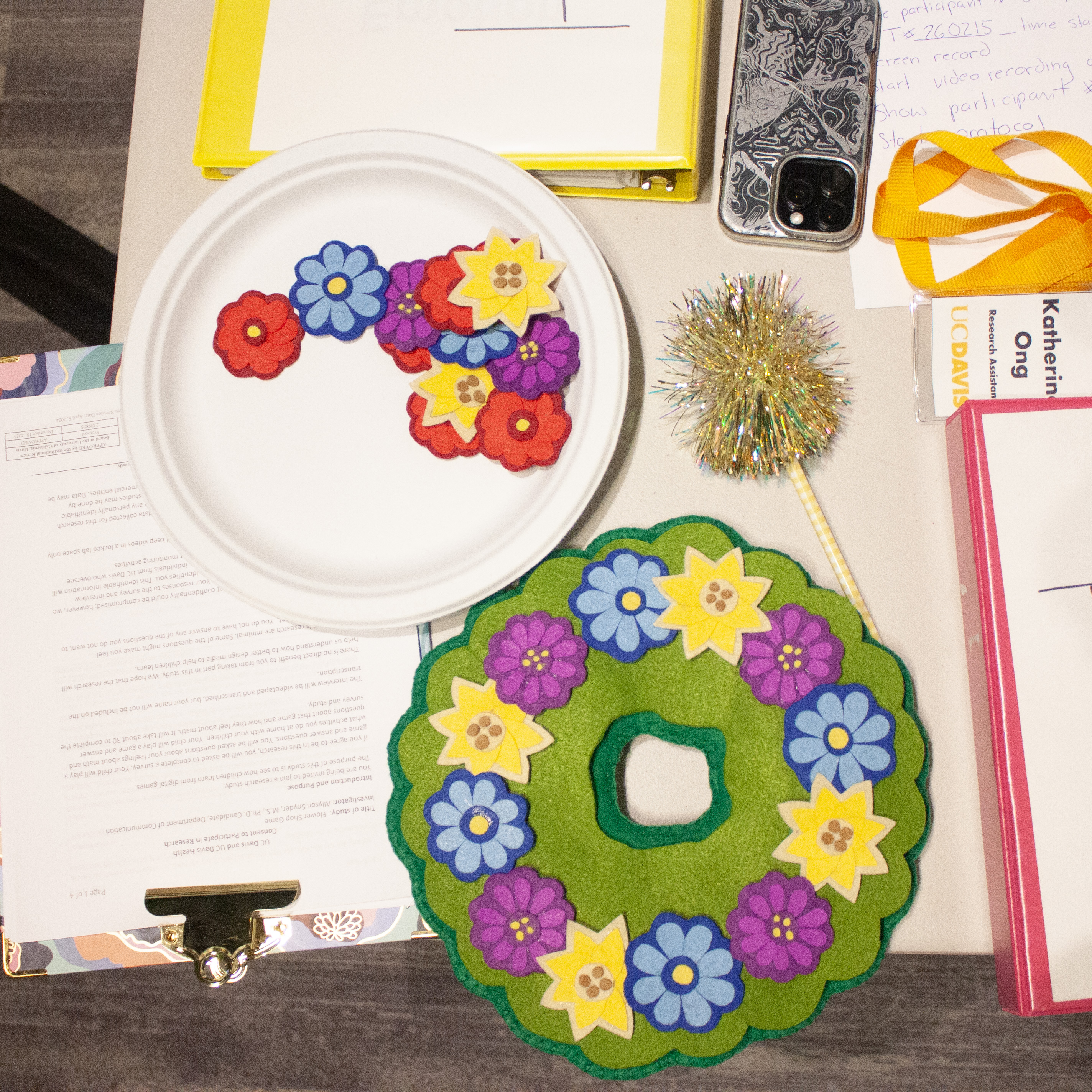
Less than an hour after MOSAC opened its doors, the floor was full of children and parents curious about the game and the science. Children too young to participate could even play with a felt version of the wreath and flowers created by Megan Plunkett, an M.F.A. student in the Department of Design who created supplemental art for the game.
That day, Snyder wore a UC Davis T-shirt with a special phrase added to the back with sparkly silver letters: “Want to be a junior scientist? Ask me how.”
Some parents were hesitant about letting their kids try an app on a tablet, worried about too much screen time already. However, Snyder compared digital learning apps like Wreathies to Sesame Street, which leverages kids’ interest in memorizing radio jingles and TV ads to teach early reading and math skills.
“I’m pro-technology,” said Janine Low-Marchelli, whose daughter took part in the study at MOSAC during their visit. “It’s a reality of our life. We prefer kids to do things outdoors, but I work all day on a computer myself.”
Preliminary data from the study suggest that kids do prefer to have choices, even simple ones about the customer whose request they take and the color of the bow when the job is done.
“Kids who get choices do feel like they’re in charge,” said Snyder.
The research team continued to ask kids for feedback on how to improve the app. Kids who approach video games with something like a professional seriousness lit up to hear that.
“Getting children’s input is so important,” said Snyder. This fall she will join Western Michigan University as an assistant professor.
One girl asked when Wreathies is going to be available for download in the app stores, though for now it’s only for research.
“That was really sweet,” said Sofia Rhea, a Ph.D. candidate in communication who will co-author the eventual paper that comes out of this study.
“We just want them to play,” added Snyder, “and hopefully learn something.”