
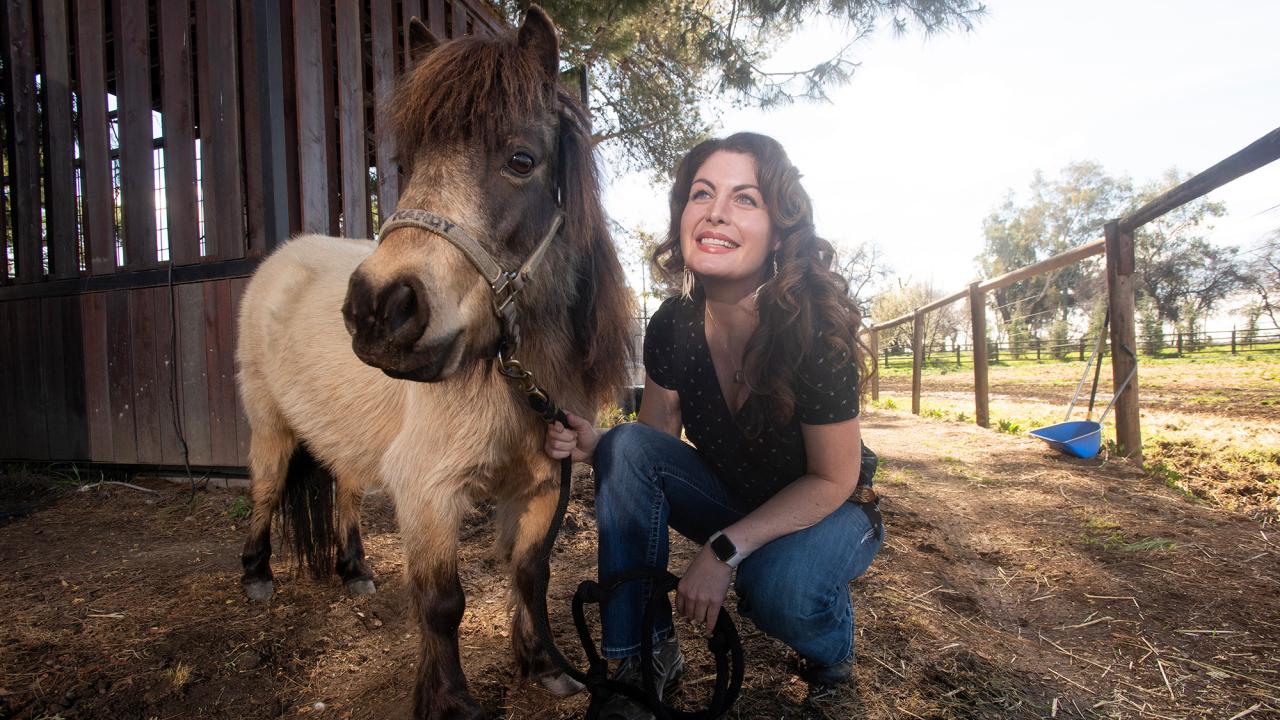
The moment Rebecca Calisi-Rodriquez loosens her grip on Randy’s lead, the miniature horse drops his nose toward the nearest patch of grass and pulls her sideways with confidence. She laughs and lets him continue his landscaping, unbothered that her walk around the Skyheart Sanctuary property is taking longer than normal.
For Calisi-Rodríguez, associate professor of neurobiology, physiology and behavior at UC Davis, the hours away from campus are spent at a sanctuary of miniature equines, pigs and goats, a youth program she built from scratch, and a rotating cast of undergraduate interns.
Calisi-Rodríguez conducts research in animal behavior, stress physiology, and behavioral neuroendocrinology, which led her to understand how animal relationships regulate biology. “At some point I realized I didn’t want to just publish about those findings,” she said. “I wanted to build a place where people could experience them.”
She founded Skyheart in 2022 in partnership with the owners of Pine Trails Ranch, a 22-acre property in west Davis that serves as both a sanctuary for rescued farm animals and a living laboratory for her Green Care Lab at UC Davis. The sanctuary exists to give animals in need a safe and loving home, and to recognize that the humans who care for animals often experience healing themselves.
The resident animals arrived in different ways. Some are from families that lost the capacity to care for them; others come from more dire circumstances. Randy’s mother was rescued from a feedlot and is just one of the sanctuary’s many success stories. Regardless of where they came from, Skyheart can give them a “forever home,” Rodríguez said.
Calisi-Rodríguez funds the sanctuary through grants, donations, summer camps, and the Healing Hooves program, which she started two years ago. Healing Hooves brings small groups of kids aged 10 to 15 to work directly with the sanctuary's herd. Under the guidance of a lead instructor, students learn about animal cognition and welfare, conduct health checks, and take the animals for walks.
“The programs I do through Skyheart are what keep them in horseshoes, keep them fed, and pay for their veterinary care through UC Davis,” Calisi-Rodríguez explained.
Though Skyheart isn’t affiliated with UC Davis, the two worlds are never far apart. Her Green Care Lab studies the effects of animal-assisted programs on human well-being and provides an opportunity for undergraduate students to get hands-on experience on the ranch.
“Rescued animals have histories. They remind you that behavior always has context,” Calisi-Rodríguez said, glancing down as Randy tugs the lead toward another promising weed along the trail. “That awareness has made me a better teacher. I think more about the nervous systems in the room, not just the brains. Students also arrive with histories.”