
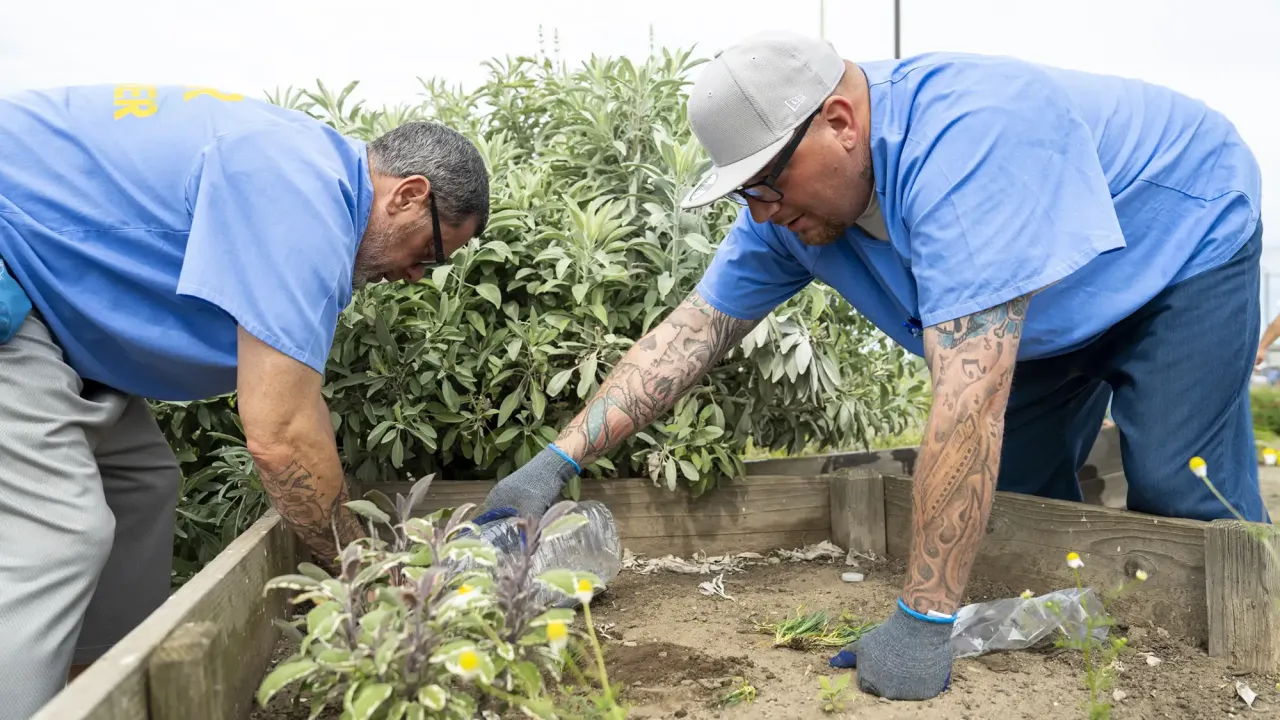
A kestrel swoops to grab a smaller bird on the wing and eats it, right in front of a group of men in the garden at California Health Care Facility, or CHCF, a prison in Stockton, where the garden has become both a thriving ecosystem and a science classroom for people incarcerated there. As the feathers fly, UC Davis researcher Laci Gerhart pulls out a bird guide and shows the incarcerated men how to identify the bird by its size and coloration, noting that kestrels are North America’s smallest raptor and one of the few that are sexually dimorphic.
That’s just one example of how the prison yard has become surprisingly fertile ground for scientific learning, thanks to a collaborative effort between the School of Education and the College of Biological Sciences at UC Davis.
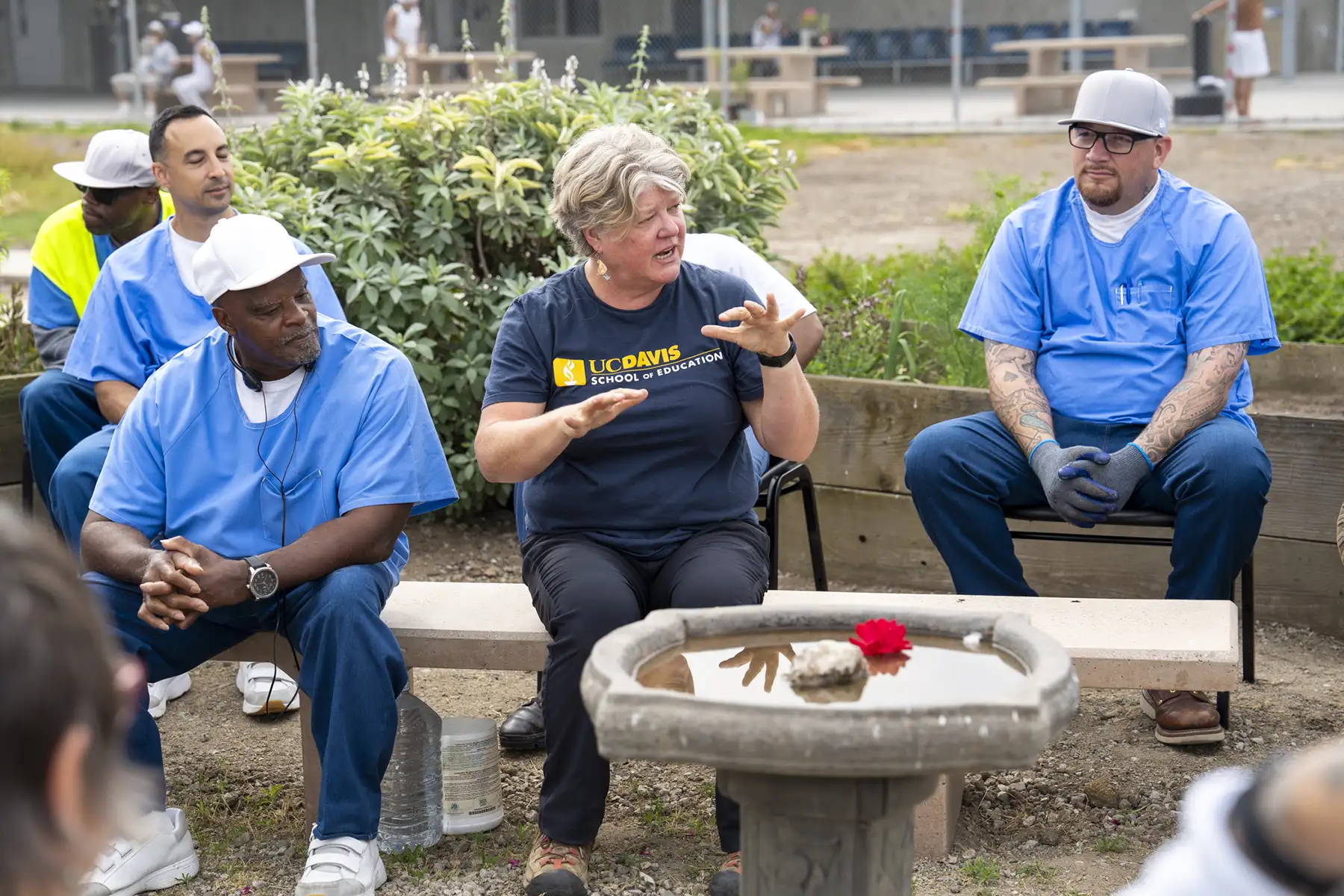
The collaboration — among Heidi Ballard, a professor in the School of Education and the founder and faculty director of the Center for Community and Citizen Science, or CCCS; Ryan Meyer, the executive director of the center; and Gerhart, an associate professor of teaching in the Department of Evolution and Ecology — recently won a $1.9 million federal National Science Foundation grant to teach participatory science in California’s prison system in partnership with the nonprofit Land Together. They aim to foster lifelong learning and environmental stewardship in one of California’s most marginalized populations: incarcerated people.
Powerful science in action
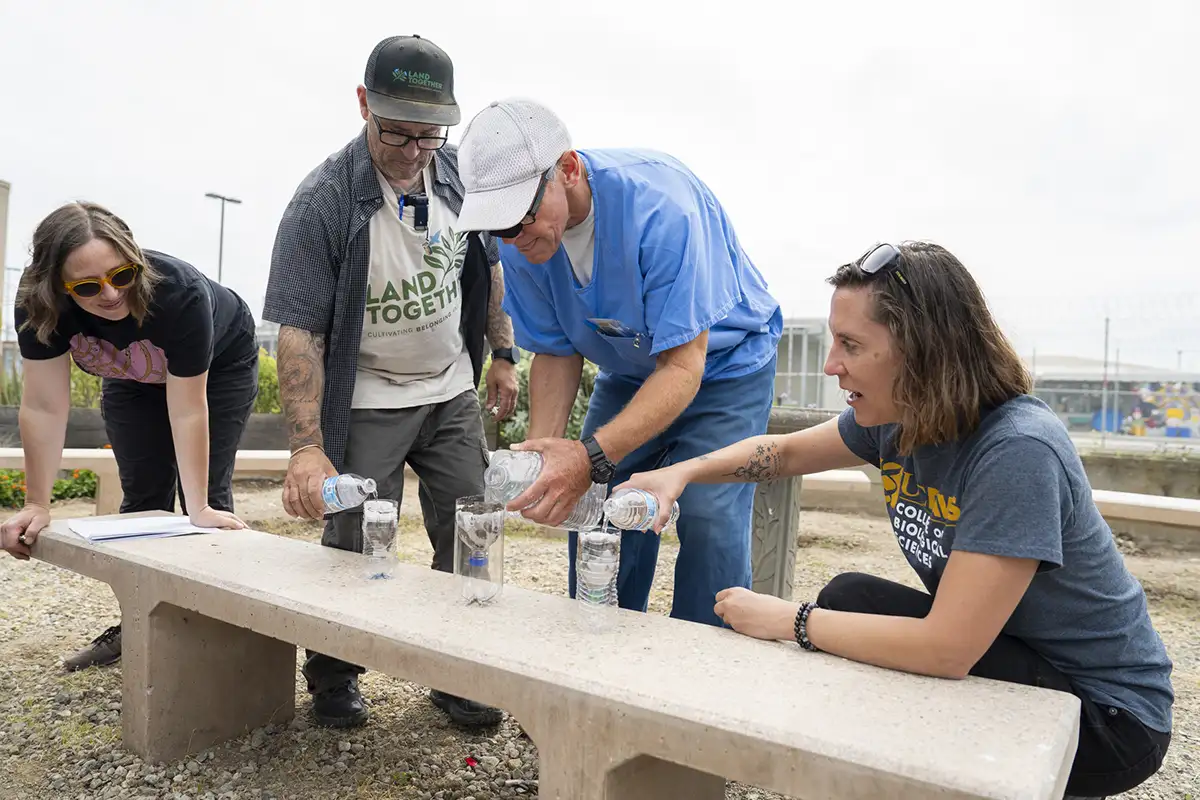
The trio have already been working to integrate real-world science in action into Land Together’s existing Insight Garden program, an eco-therapy program that uses hands-on work in prison gardens as a metaphor for cultivating participants’ inner gardens and that has been shown to sharply reduce recidivism. Adding more scientific content to that program has taken many forms, from identifying birds like the kestrel to documenting pollinator data for The Great Sunflower Project.
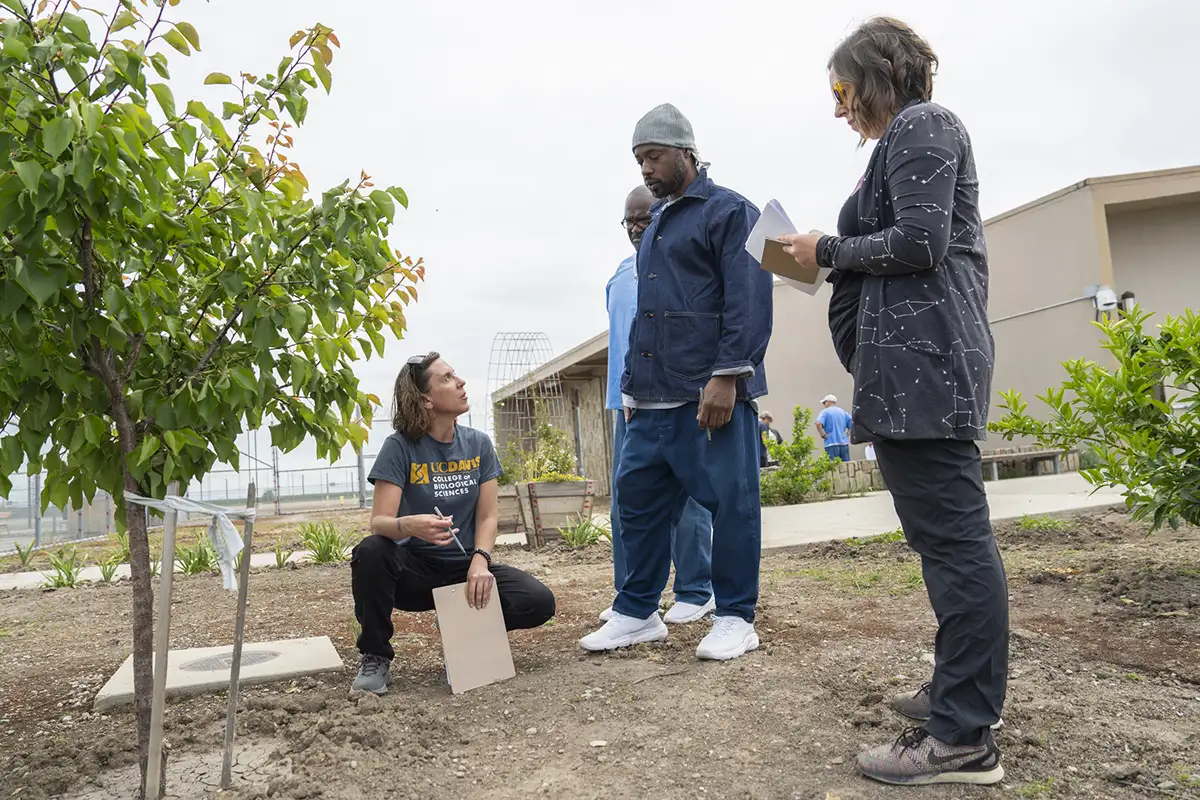
The new grant formalizes the partnership, expanding its work by funding four project components: developing a curriculum focused on science in the garden at CHCF; teaching the course to incarcerated men, who can earn certification as California naturaliststhrough UC Environmental Stewards; studying the learning that happens during the course, focusing on how participants develop “science identity” and sense of self-efficacy; and developing instructor training materials so their curriculum can be implemented statewide.
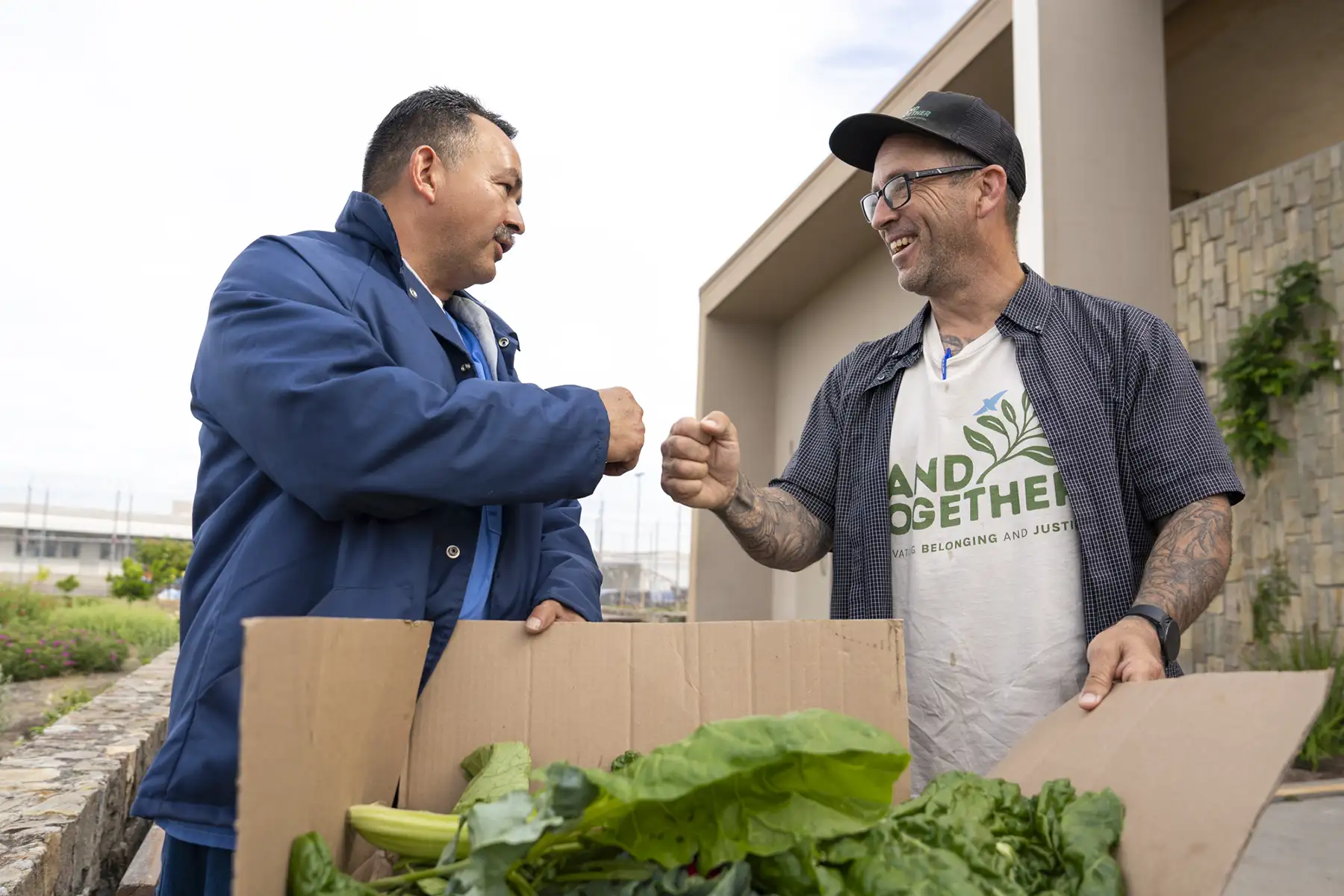
Gary Burt, a social worker and program manager at Land Together who is himself formerly incarcerated, said he can already see the collaboration’s promise. “I’ve had folks tell me that the two hours they were in the garden, it’s like those prison walls and electric fences were not there. They were part of a community, part of nature, and now we’re implementing STEM aspects that put them a step ahead in reintegration back into society,” said Burt. “It’s some of the most groundbreaking, impactful work I’ve ever experienced.”
Sowing seeds for a ‘truly magical’ collaboration
The seeds for the collaboration were sown some 10 years ago, when Ballard recruited Meyer, whose background is in science and technology policy, to co-found and lead CCCS. Many of the center’s grants and partnerships focused on participatory science in schools, including school gardens — a natural parallel with prison gardens. Meyer connected with Land Together (then called Insight Garden Program) and visited CHCF’s prison garden.
“It was the first time I’d ever been in a prison, and I was just totally changed,” said Meyer. “The contrast between the severity of the institution and meeting these men who were completely engaged in the garden curriculum made me realize this would be an amazing space to work if you can find a good way in.”
The men Ballard and Meyer met were already engaged informally in citizen science. “The men were making really thoughtful close observations about all the animals and plants they’ve seen in their garden, and we realized this could be amazing,” said Ballard. Those observations of butterflies, birds, and other creatures could all add to broader scientific learning through such initiatives as the Great Sunflower Project.
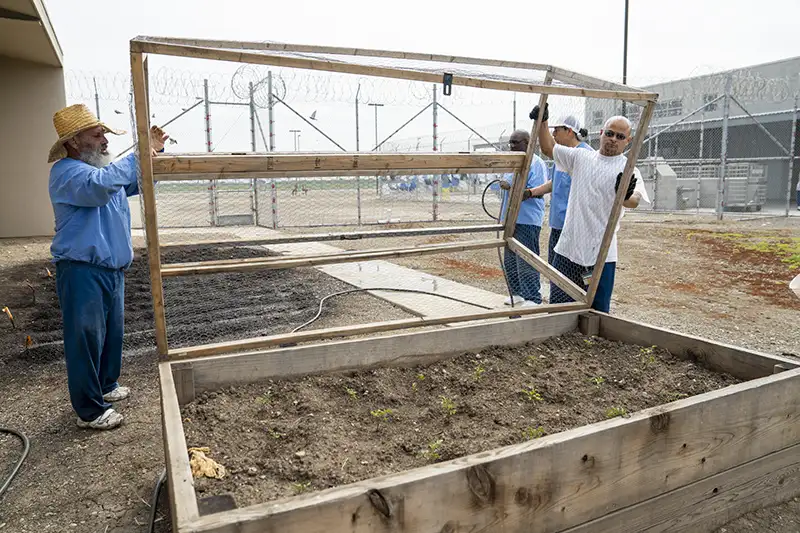
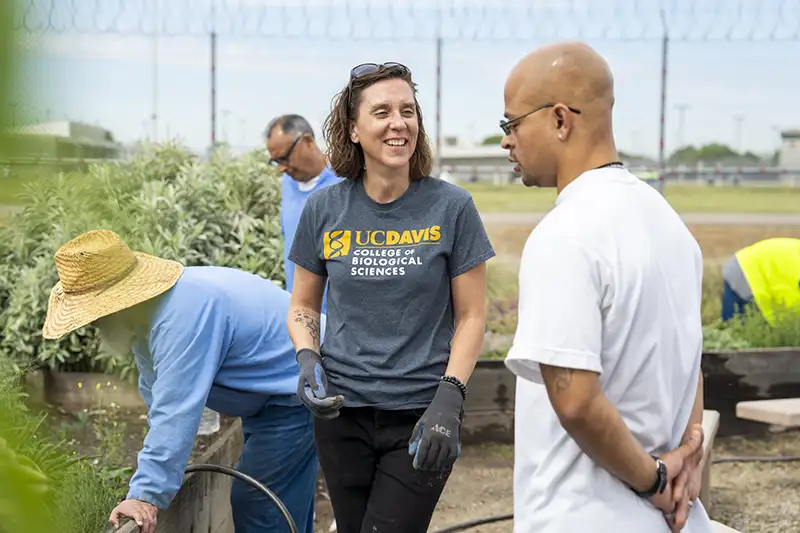
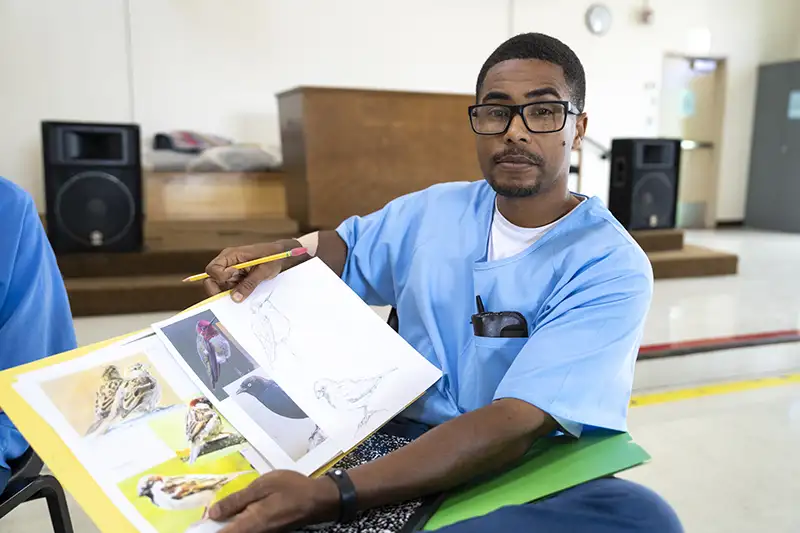
Meyer and Ballard started slowly, with site visits and listening sessions, before landing a small grant from UC Davis’ Office of Public Scholarship and Engagement.
Around that time, Ballard and Meyer brought in Gerhart, whose popular course Wild Davis teaches natural history and participatory science to undergraduates.
Like Meyer, Gerhart said she was hooked from her first visit to Mule Creek State Prison. “It didn’t have a garden yet, just a prison yard with lots of concrete. So I asked what kind of wildlife we would see there, and of course the guys assume we’re not going to find any. I was very proud that we found a frog,” she said. “Afterward, Ryan asked me how I liked it, and I said, ‘I don’t know how to say I had a good time in prison today.’ It’s this weird cognitive dissonance of being in a deeply inhumane space, but the work we’re doing feels amazing. The guys are hungry for knowledge and curious about nature and science.”
Gerhart, who works with UC Environmental Stewards in teaching Wild Davis, realized the California naturalist program could also provide a model for augmenting Land Together’s existing garden programming with STEM learning. California naturalist certification includes such requirements as lessons about California’s unique ecosystems, contributing observations to the course’s iNaturalist project, and completing a capstone project, but the course content is highly adaptable, said Gerhart: “For instance, you have to study the soils and geology of California, but the actual activity you do is very flexible.” That means the incarcerated men can meet the requirements by studying soil in the prison yard.
The result was a rich synergy, said Gerhart, who is now the lead principal investigator on the federal grant.
Calliope Correia, Land Together’s regional lead for its garden program, underscored the importance of the UC Davis connection. “It’s huge to have this STEM content facilitated by UC Davis professors to give the men connection and access to higher education, as well the California naturalist certification they can take with them after release. Adding to the garden experience in ways that lower the barriers they face to education and re-entry is truly magical,” she said.
Bringing science to an overlooked population
Although the federally grant-funded phases are just ramping up, the collaboration between UC Davis researchers and Land Together has already led to publications: a chapter the researchers co-authored with Correia and others in Handbook on Lived Experience in the Justice System (Routledge, 2026), and the self-published Guide to the Birds of CHCF, funded by a small earlier grant and written and illustrated primarily by the facility’s incarcerated men, with support from Ballard and Meyer and an introduction contributed by Burt.
“The men had so many wonderful stories about the birds they love that they wanted to share with other incarcerated people and their families outside,” Ballard said, “so it was a joy to pull it all together.”
The guide includes personal stories and artwork from its more than 20 contributors, in addition to hand-drawn illustrations, photos and descriptions for identifying birds. “It points to the kinds of things that are possible as we look toward piloting the California naturalist curriculum,” Meyer said, “people doing capstone projects, or contributing to their own community.”
The guide underscores the connection to nature that incarcerated men have nurtured against steep odds. In his introduction, contributor Omar Dent III wrote: “The goal of this guide is to inform — to inspire — to motivate — to give joy — and to help everyone appreciate the surprising diversity of nature surrounding us. Most importantly, this guide will offer its reader a view into a place where some believed that beauty could not exist.”
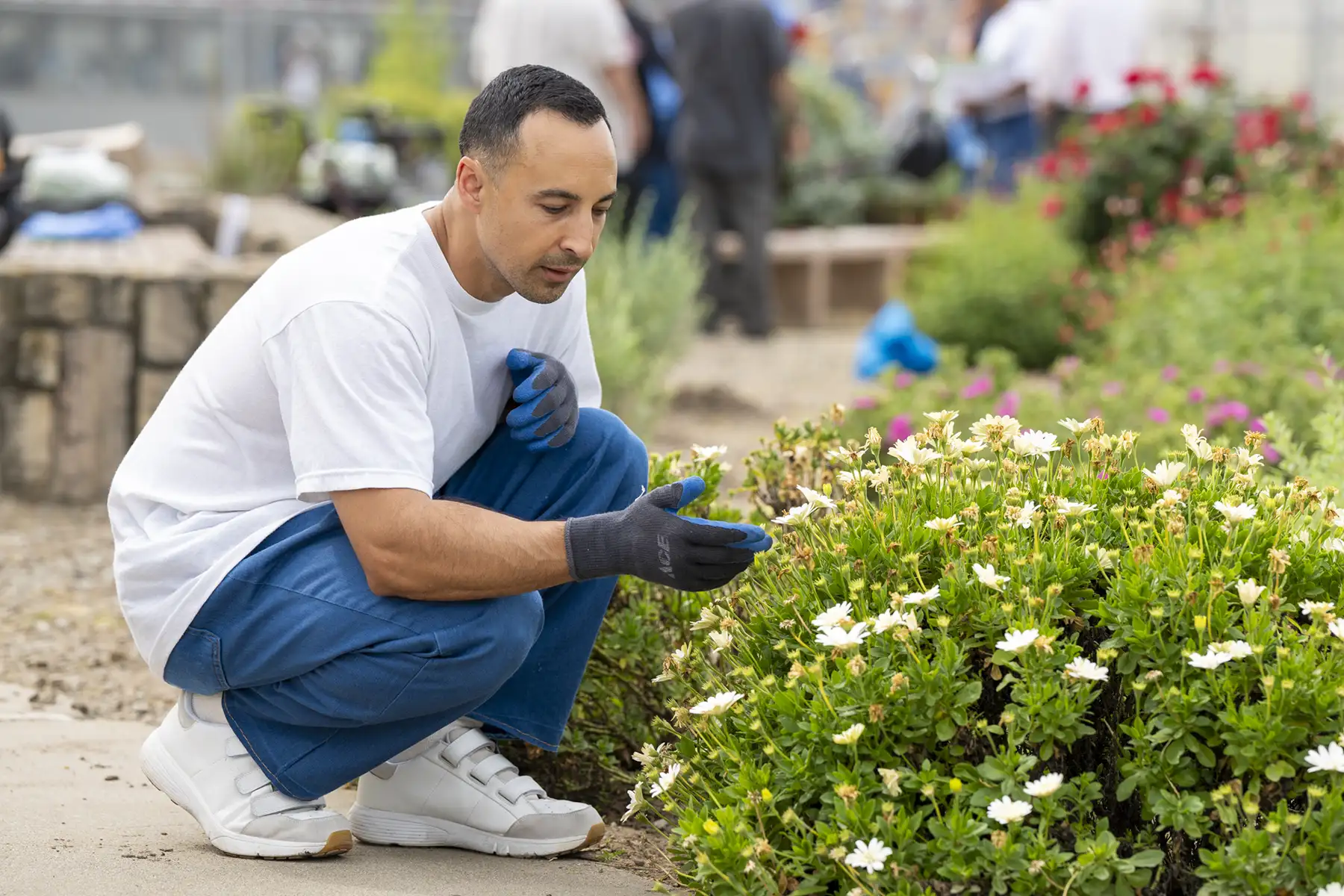
Garden observations have led to funny moments as well as poignant ones, Gerhart recalled. “During a pollinator activity one of the guys found the most beautiful, brilliant green spider I’ve ever seen. I said we should catch this to show the other guys, and I picked it up. The five big burly dudes around me just lost their minds that I touched a spider.”
Prison education includes hurdles: bureaucratic red tape, rigorous ethical standards for research on incarcerated subjects, and the fact the trio cannot bring standard teaching technology into the prison means a lot of forethought goes into making the curriculum effective. But Ballard, Meyer, and Gerhart said they aren’t afraid to think creatively and dream big about the future of their work. The fourth component of the grant, scaling their curriculum for use statewide, is all part of a larger effort to spark self-actualization through science for people marginalized by the carceral system.
For Ballard, integrating real-world science and equity-focused education into prison settings dovetails with both her own values and the UC system’s larger mission of public service. “I’ve always tried to focus on equity and justice in science education, but prisons weren’t even on my radar. They just get forgotten by those of us who have the privilege to forget,” she said. “But there is a huge population of people in prison, unfortunately, and if the University of California wants to serve the people of California, we should be serving everybody.”