

Stroll through a grocery store and pick up a plastic container of strawberries. How do manufacturers know where to put holes in the clamshell for the best airflow?
Questions like those have been at the heart of food engineer R. Paul Singh’s research at UC Davis for the past 50 years, but the answers aren’t always easy to find.
“Food is actually a very, very complex material,” Singh said.
Because strawberries come in a variety of different shapes and sizes, it can be tough to predict how they will react inside a cooler, but that’s where computer modeling can help, he said.
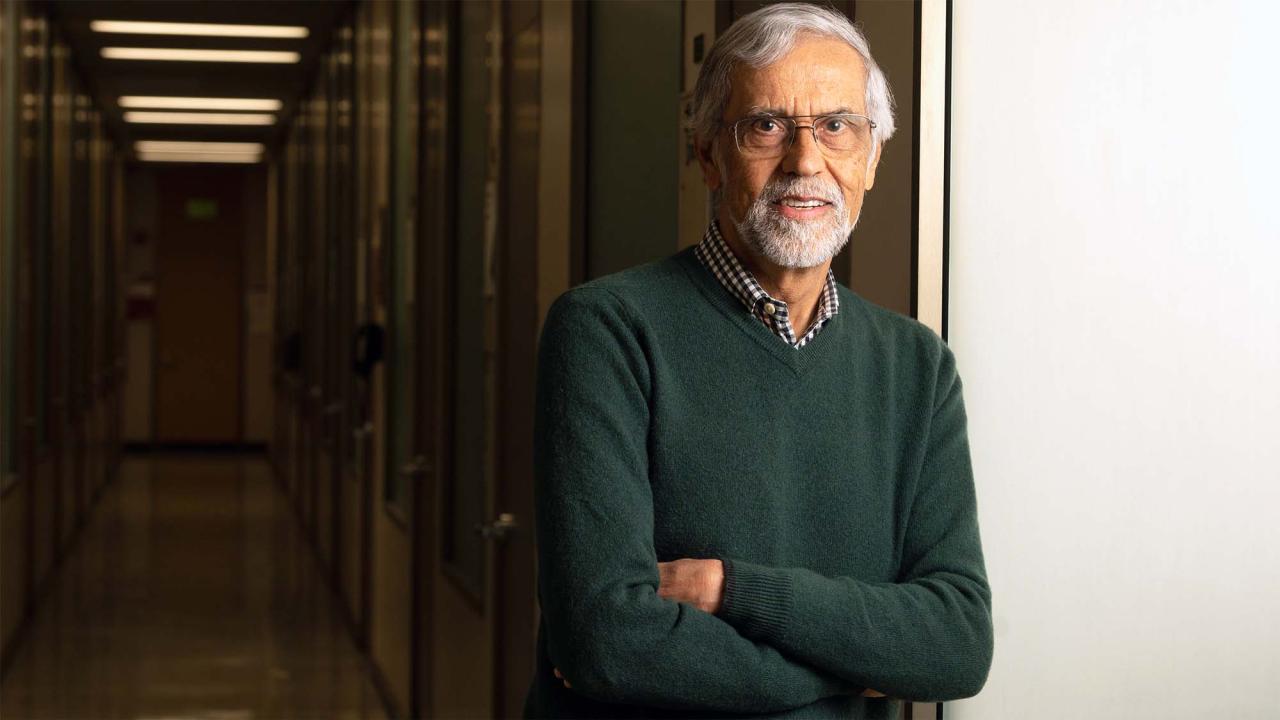
Singh is a distinguished professor emeritus in the Department of Biological and Agricultural Engineering. Since joining UC Davis in 1975, he has worked on ways to transport and preserve food, studied how food changes when it freezes and thaws, and developed models to predict how nutrients from food will be absorbed into the body. Many of his biggest projects received federal funding and led to increased efficiency for farmers and processors.
A longer shelf life
Singh’s interest in the subject began when he was an undergraduate in his native India, and an agricultural revolution led to vast increases in the production of crops like wheat and rice, creating challenges around distributing the food before it spoiled.
He began to look for ways to use computers to model how food would react, for example, when finding the best temperature air to use in rice dryers or when cooking pizza in an impingement oven.
AMONG THE ACADEMIES
UC Davis has more than 50 faculty members who belong to the National Academies of Sciences, Engineering and Medicine, a recognition of their distinguished and continuing achievements in research. The academies are among the most prestigious membership organizations in the world.
Each month, Dateline UC Davis will profile one of these faculty members in honor of their contributions to scientific research and knowledge.
In most cases, Singh wasn’t designing physical products — he was helping to model and understand how food would react in different situations, like when strawberries are placed into those plastic clamshells inside a walk-in cooler.
“Many times you just don't get proper airflow through it,” Singh said. “So there may be strawberries within that package that may not get a sufficient amount of air to cool them down, and they will start spoiling.”
Efficiency has been a major outcome of his work, and he has spent time showing Salinas strawberry farmers how to cut down on spoilage, designing more efficient canning machinery for a major plant in Modesto and even developing a computational model of a stomach after the idea came up over a cup of coffee while on sabbatical in New Zealand.
“It's a way to cut down food waste because you are cutting down the spoilage that will otherwise occur,” he said of his work.
His research has led to numerous accolades, like several awards from the Institute of Food Technologists, membership in the Food Engineering Hall of Fame, honors from the American Society of Agricultural and Biological Engineering and, in 2008, membership in the National Academy of Engineering.
Sharing his knowledge
Singh has long focused on spreading his expertise to anyone, not just his collaborators on campus. In 1999, he published a paper with Professor Francis Courtois of the University of Montpellier in France about his experience allowing students around the globe to remotely control equipment in his lab. They would recreate experiments that his students had just run, using the same equipment in Davis, then email their own reports to him, Singh said.
“Any person around the globe — through the internet — could operate that equipment,” he said. “The only thing in those days was that we had to tell the custodians to make sure they didn’t turn off the light at night because some of them were running experiments in the middle of the night.”
A subsequent paper, published in 2005 with collaborators from the Mexican institution Universidad de las Américas, Puebla, chronicled the expansion of that project to add more experiment options for online visitors.
Several years later, as Singh neared the transition to emeritus status, he began publishing videos of short lectures and instructions for more than 20 experiments, combining to an entire introductory course in food engineering. He has since posted more than 200 videos and gained nearly 38,000 subscribers; Singh said he has had viewers from every country where YouTube is allowed.
“These tutorials have been a way for me to give back to the community,” Singh said, noting that the videos saw another surge in popularity during the COVID-19 pandemic.
An increasing need
As Singh reflects on his career, he said UC Davis was always the obvious choice for his work — not just because of its agricultural connections, but because of its emphasis on both defined projects and endeavors led by curiosity, like the stomach model.
“I knew that this is the place,” he said.
He has witnessed numerous changes in his field over the years, but thinks it will become even more important as the agricultural industry faces increased demand from growing populations and more difficult growing conditions because of climate change.
“We will need to be designing systems that are more sustainable from resource use, from how we handle food,” Singh said. “When it comes to food losses, we will have to be better and minimize food waste.”
Ultimately, the world will need to find a way to feed people more nutritious food, more sustainably, he said. And he thinks universities like UC Davis will play a key role.
“That all comes down to the education side, because you need to prepare the next generation of students who are addressing some of these problems.”
Media Resources
Cody Kitaura is the editor of Dateline UC Davis and can be reached by email or at 530-752-1932.