

To the UC Davis Community:
When I am asked what makes UC Davis special, one of the first thoughts that always comes to mind is our collaborative spirit. We learn together. We work together. We look out for one another. And together, on our Davis and Sacramento campuses and beyond, we partner on research that addresses the greatest challenges of our times.
Our commitment to collaboration has reached new heights, thanks to a $120 million gift from Joan and Sanford I. Weill. This generous contribution through their family foundation marks a historic turning point and a new name: the UC Davis Joan and Sanford I. Weill School of Veterinary Medicine.
The gift will strengthen UC Davis’ leadership in comparative medicine and enhance collaboration among veterinary medicine, UC Davis’ School of Medicine, and other entities. This kind of synergy will help power critical advancements in our One Health approach to animal and human health. It’s an interdisciplinary way to address global health problems that recognizes how the health of people, domestic animals and wildlife are connected in complex ways.
But our work doesn’t stop there.
After all, complex challenges require a cross-disciplinary perspective that allows researchers to share knowledge. It allows for an array of perspectives and expertise, resulting in more comprehensive solutions. This is especially crucial as the needs of our communities grow more urgent.
Collaboration includes our patients and their families, along with community networks and organizations that are a major part of making our research available to those who need it most. For example, in recent years, the UC Davis Comprehensive Cancer Center expanded its clinical trials. Now, about 400 patients are enrolled in various studies, with the goal of finding better ways to treat cancer. UC Davis has also expanded clinical trials to rural communities through affiliate networks in Northern California, in partnership with community hospitals.
At UC Davis, we’re committed to investing in the kind of collaboration that makes all of this and more possible. At the same time, we must make our voices heard. We must advocate for federal funding to help us find solutions to the world’s most pressing issues.
Collaboration powers innovation
Our collaborative leadership and the work we develop together laid the foundation for innovations.
In one recent example, a groundbreaking brain surgery on a kitten could one day save human lives as well. The team included neurosurgeons from UC Davis Children’s Hospital and the Weill School of Veterinary Medicine. Together, they are learning how the surgical technique could be adapted to heal human babies with hydrocephalus, a dangerous buildup of fluid in the brain.
UC Davis is also on the cutting edge of research into treating neurodegenerative disorders, such as Alzheimer’s disease and Parkinson’s disease, which together affect more than 8 million people in the United States. Trials are currently underway at UC Davis’ Institute for Psychedelics and Neurotherapeutics that could treat and even reverse neurodegenerative disorders. Their collaborations stem from a wide range of fields, including faculty in sociology, psychology, chemistry, medicine, cognitive science and economics.
Cross-disciplinary research is also key to the field of artificial intelligence. Professor Martin Hilbert in the Department of Communication bridges social sciences with technology in addressing the ethical components of AI, its risks to children and effects on the scientific method.
This multi-disciplinary approach applies to our pursuits in the arts and humanities as well. A key mission of the Maria Manetti Shrem “Arts Renaissance” is safeguarding the arts and humanities while fostering an unprecedented level of collaboration across campus.
Our interdisciplinary experts from the widest possible range of fields are invited to contribute to art creation, including engineers, historians and scientists of all types. Ultimately, the creative process that inspires art can spark new ways of thinking and working across many fields.
UC Davis postdoctoral scientists and graduate students are also key research collaborators. In the Neuroprosthetics Lab, a team of neurosurgeons, neuroscientists and Ph.D. students worked together to develop brain-computer interfaces that translate brain signals into speech. The technology has the potential to give people with paralysis greater autonomy.
Collaborating with the wider world
UC Davis is also driven to form impactful partnerships that go beyond our university boundaries. That includes collaborating with our colleagues at UC Irvine and UC San Diego to develop air monitoring technology. Beyond that work, UC Davis and UC San Diego are using AI in radiology to co-lead large studies to improve mammography accuracy and enhance patient trust in AI-assisted screening. UC Davis is also working with UCLA and Cal Fire to investigate how occupational exposures among firefighters may increase cancer risk.
Collaborative work can also be seen at the College of Agricultural and Environmental Sciences, where faculty and students are engaged in interdisciplinary research related to air quality. They are part of the Community Air Project, which measures toxic metals in the air using novel technologies that could be used widely across the state. The collaboration includes community groups along with UC San Diego and UC Irvine.
Professors Cristina Davis and Zhaodan Kong of the College of Engineering are working with the National Science Foundation’s Center for Pandemic Insights, which is led by Weill School of Veterinary Medicine Professor Christine Johnson, to conduct multidisciplinary research with the Marine Mammal Center in Sausalito, the San Diego Zoo Wildlife Alliance and Colorado State University. Along with UC Davis, the team is developing chemical sensors and drones to prevent global disease outbreaks.
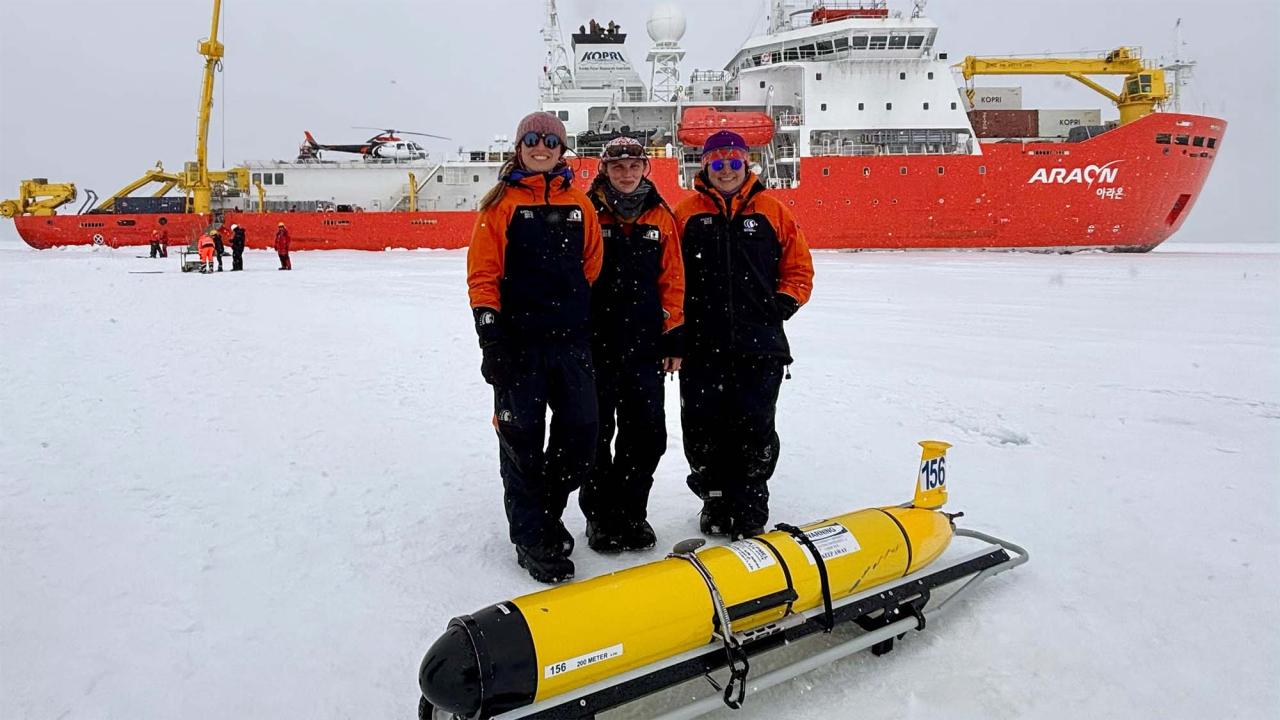
In Antarctica, scientists from the College of Engineering and the UC Davis Tahoe Environmental Research Center collaborated with nearly 40 international researchers to study melting glaciers. They use underwater vehicles called “gliders” to determine how much water has melted from the ice shelf and the implications for rising sea levels.
Here’s a final example that resonates especially with me, given my early dreams of becoming an astronaut. Graduate students from the UC Davis Center for Space Exploration Research collaborated with Proteus Space Inc. on a satellite project. This marked UC Davis’ first satellite payload launch into space, which happened in late November.
In an interview with UC Davis Magazine, one student said: “Spaceflight takes everything … You have people from all different walks of life, and they don’t exactly talk the same language at first. There’s interpretation at first that leads to collaboration.”
Moving forward and speaking up
It’s this kind of visionary partnership that powers American innovation, and it’s this kind of collaboration that powers UC Davis.
We must continue to support interdisciplinary and collaborative research and maintain our wide-ranging partnerships to harness our power to spark discovery and innovation.
It’s also critical that we stand up for federal research funding that allows us to find solutions for the world’s most pressing issues. This research is crucial to making discoveries that create a better tomorrow, from the health of all living beings and protecting our environment to feeding a growing planet.
We’ve already seen funding cuts affect some of our collaborative projects such as the Feed the Future Innovation Labs, which were closed last year. These labs, in partnership with the U.S. Agency for International Development, or USAID, were on the frontlines of promoting global food security and inclusive agricultural growth.
We cannot afford to have more examples like this. So, I encourage you to stay updated on our From Labs to Lives campaign, which explains the impact of our research at UC Davis and what’s at stake when we lose federal funding.
Feb. 25 marks the first anniversary of this campaign, which has garnered over half a million impressions online. We’re celebrating with a campuswide web and social media takeover to show how much federal funding matters to our work. I encourage you to nominate a UC Davis researcher or someone who has benefited from federally funded research to be featured as a From Labs to Lives “champion.”
I hope everyone is doing well in these final weeks of the winter quarter. Let’s keep collaborating and working together to shape a better tomorrow.
Sincerely,
Gary S. May
Chancellor