

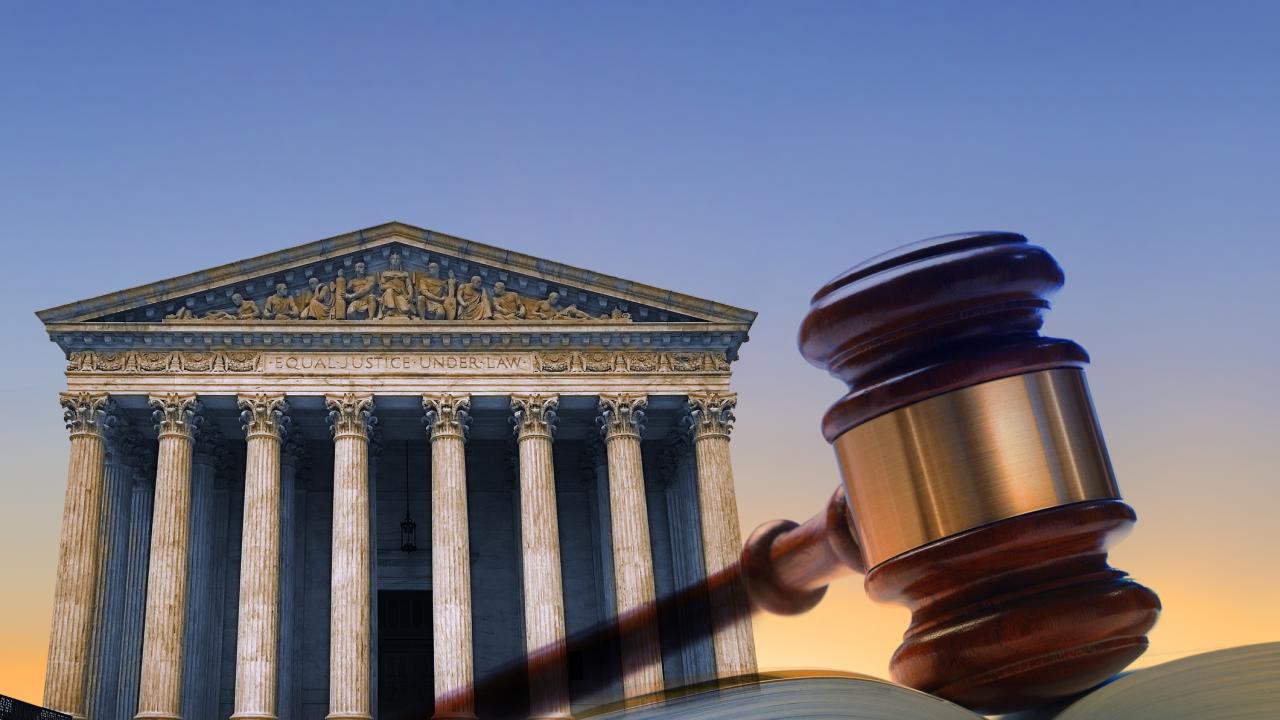
Cases pending before the U.S. Supreme Court range from those about citizenship, to transgender issues, to the Second Amendment. In the following cases, professors from UC Davis School of Law are prepared to answer questions for the media. Their biographies (hyperlinked) and contact information are below. For any of our experts on various issues, media may wish to go to www.ucdavis.edu/news/experts.
This list is for media use only.
Immigration
Two notable immigration cases remain to be decided. The Court is weighing whether asylum seekers presenting at the U.S. border maybe lawfully turned away — or whether they must instead be inspected by immigration officials and entered into the asylum system for further processing in Mullin v. Al Otro Lado.
In Mullin v. Doe, the Court will determine whether the Trump administration improperly removed the temporary protected status, or TPS, of Syrian and Haitian nationals. The TPS program permits qualifying foreigners to remain in the U.S. because it would be too risky for them to return to their home countries.
Contacts: Professors Kevin Johnson, krjohnson@ucdavis.edu; and Raquel Aldana, realdana@ucdavis.edu
Birthright Citizenship
In an executive order, President Trump seeks to deny the constitutional guarantee of birthright citizenship to children whose parents are illegal immigrants or lawfully present as temporary visitors. Trump v. Barbara asks whether that executive order is unconstitutional.
Professors Johnson and Gabriel “Jack” Chin (gjchin@ucdavis.edu) have commented in the media on the matter. Professor Vikram Amar (vdamar@ucdavis.edu) has co-authored an amicus brief on the case.
Telehealth, abortion pill by mail
The Supreme Court ruled on May 14 that the abortion pill mifepristone can continue to be prescribed online or over the phone and sent through the mail. The Court’s order continues to block a ruling by a federal appeals court in Louisiana which had barred the mailing of mifepristone, one of two drugs used in medication abortions — the most common form of abortion in the United States. Contact: Professor Mary Ziegler, mziegler@ucdavis.edu
Guns and the Second Amendment
Two major guns cases remain to be decided. Wolford v. Lopez asks whether Hawaii violated the Second Amendment's right to keep and bear arms when it told licensed concealed carry permit holders that they must obtain the express permission of the property owner before they may carry a handgun on private property that is open to the public. Second, in United States v. Hemani, the justices are considering whether a federal law that prohibits illegal drug users from having guns violates the Second Amendment.
Contact Professor Carlton Larson, clarson@ucdavis.edu
Presidential control over federal agencies
Two cases fall into this category. In Trump v. Slaughter, the question is whether President Donald Trump may fire a commissioner of the Federal Trade Commission for purely political reasons, rather than "for cause." There is a 1935 Supreme Court precedent that says the president may not fire an FTC commissioner for purely political reasons. The case is effectively about whether that precedent should be overruled, limited, or left standing (and thus enforced against Trump).
The case of Trump v. Cook, asks instead whether Trump's ostensible "for cause" firing of Lisa Cook from her position as a member of the Federal Reserve's Board of Governors satisfied the terms of the "for cause" requirement in federal law, or whether it was really just a pretext designed to cover up Trump's illegal political rationale for firing her. Contact: Professor Vikram Amar, vdamar@ucdavis.edu
Transgender athletes
The Supreme Court heard back-to-back oral arguments in January in a pair of cases that each involve a government ban on transgender women and girls competing in women's and girls' sports. The question presented to the Court in the first one, Little v. Hecox, is "whether laws that seek to protect women's and girls' sports by limiting participation to women and girls based on sex violate the Equal Protection Clause of the Fourteenth Amendment." The question presented to the Court in another case, West Virginia v. B.J.P., is "whether Title IX prevents a state from consistently designating girls' and boys' sports teams based on biological sex determined at birth."
Contact: Professors Courtney Joslin, cgjoslin@ucdavis.edu, or Brian Soucek, bsoucek@ucdavis.edu
Fourth Amendment searches
The case of Chatrie v. United States originated when law enforcement officials told Google to search the location histories of all users to determine which users were present in the vicinity of a bank robbery. The Supreme Court is tasked with determining what the Fourth Amendment permits in such cases. Contact: Professor Elizabeth Joh, eejoh@ucdavis.edu.
Roundup cancer claims
An ongoing battle over whether Roundup weedkiller causes cancer could get curtailed or supercharged by the Court, depending on whether the justices allow the manufacturer to be sued for failing to warn of cancer risks from the active ingredient glyphosate. Bayer, which acquired Roundup maker Monsanto in 2018, faces billions of dollars in potential liability. The company has said it may have to stop selling glyphosate to U.S. farmers if the lawsuits continue, a scenario major agricultural groups say would pose a "devastating risk to America’s food supply." Contact: Professor Albert Lin, co-director of the California Environmental Law and Policy Center, aclin@ucdavis.edu.
Media Resources
Media contacts:
(Faculty may be contacted directly, as well).
- Amy Quinton, UC Davis News and Media Relations, amquinton@ucdavis.edu 530-601-8077
- Kelley Weiss, School of Law, kweiss@ucdavis.edu