

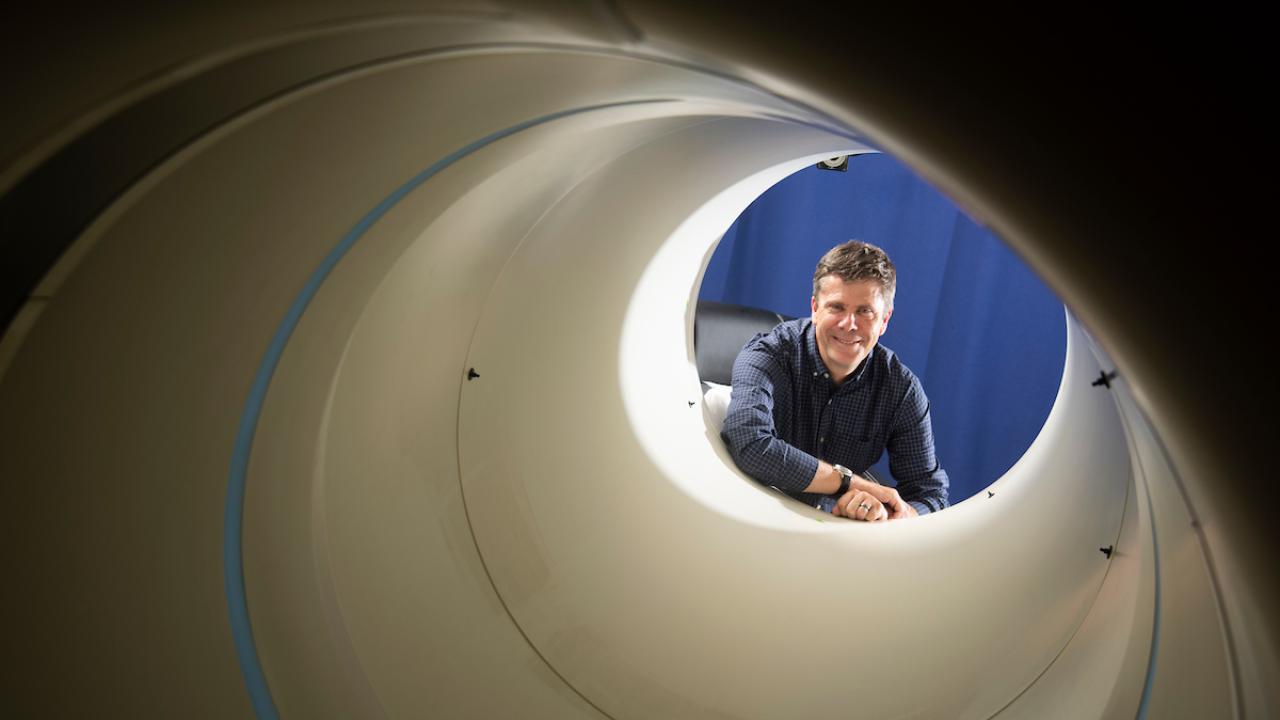
The Royal Society has elected Simon R. Cherry, a Distinguished Professor Emeritus of biomedical engineering and radiology at the University of California, Davis, to the level of fellow.
Election to fellow is given to the world’s most eminent scientists, engineers and technologists. Only 90 scientists across the globe received the honor this year, which was announced on May 27.
“I am incredibly honored to receive this recognition from one of the world's most prestigious and famous scientific institutions,” Cherry said. “I feel very fortunate to have such a wonderful career, doing things that I love and surrounded by so many bright and generous people. I’d like to thank all my laboratory members and my collaborators across the world, without whom none of this would have happened.”

The Royal Society, the oldest continually operating scientific academy in the world, elected Cherry in recognition of his seminal contributions to biomedical imaging. Through the development and application of innovative and commercially adopted technologies like the world’s first total-body PET scanner, Cherry has reshaped biomedical research and clinical medicine by enabling unparalleled insights into healthy and disease states in the human body.
Lighting the stage for medical innovation
Across his four-decade-long career, Cherry’s research has focused on molecular imaging. Molecular imaging is a type of imaging science that allows researchers and clinicians to observe how biological processes work in living subjects without invasive surgery.
Among his earliest research in this field, he worked to improve the technology behind PET scanners. In the 1990s, experts believed that the resolution of a PET image could not be improved beyond about 2 mm. Cherry proved that this was a misconception, developing the first detector technology that enabled PET scanners to break the 2 mm resolution barrier and implementing this in a “microPET” scanner, which enabled non-invasive imaging in laboratory animal models of human disease. This technology was commercialized and has been widely used in academia and by the pharmaceutical industry.
A second major contribution was the discovery that PET and MRI scanners could be combined. Cherry developed the first radiation detectors that allowed PET and MRI scans to be captured at the same time in the mid-1990s, a period when there was doubt that such a feat of engineering was possible. Throughout the rest of the decade, he remained at the forefront by building several world-first prototypes of hybrid PET/MRI scanners, which eventually led to commercial interest. Today, hybrid PET/MRI scanners are common tools in biomedical and clinical research.
A brilliance of a different kind
Perhaps his biggest advancement in medical imaging is the development and application of EXPLORER, the world’s first total-body PET scanner, with his colleague, Professor of Radiology and Biomedical Engineering Ramsey Badawi.
Traditional PET scanners are limited to imaging only about 30 centimeters along the length of a patient’s body at one time. EXPLORER can capture images of a patient’s body, from head to toe, in much shorter imaging times, with significantly less radiation and in clearer resolution.
The total-body approach allows PET imaging to be tailored to the needs of specific patients, such as detecting smaller tumors, imaging quickly in patients with claustrophobia or who are in pain and imaging children and adolescents at much lower radiation doses.
Cherry and Badawi installed the total-body PET scanner at UC Davis Health in 2019. To date, the UC Davis machine has helped approximately 7,000 patients and is currently being used by scientists in 25 clinical science research trials to illuminate how disease works in the human body.
EXPLORER has since been commercialized with about 30 systems in place worldwide, and similar systems have now become available from all major medical imaging companies. It is estimated that close to a million patients worldwide have been scanned by total-body PET technology. In 2022, Cherry received the Cassen Prize from the Society of Nuclear Medicine and Molecular Imaging, the highest possible honor in nuclear medicine, for his work on the machine.
Recently, Cherry has turned his attention to ultrafast imaging detectors. While more work is needed, his research has demonstrated that imaging precision down to 30 picoseconds (one picosecond is a trillion times shorter than a second) is physically possible, laying the groundwork for scientists to usher in the next big advancement in nuclear medicine.
“The great joy of working in the field of nuclear medicine is that it is so highly interdisciplinary, integrating physics, engineering, chemistry, biology and medicine,” Cherry said. “Every day, you learn something new, and I’m always looking for opportunities to advance technologies to help our patients by getting a clearer picture of their disease and ensuring that their doctors have the best information possible to guide treatment.”
Cherry earned his bachelor’s degree in physics and astronomy from University College London and a Ph.D. in medical physics, biophysics and radiobiology from the Institute of Cancer Research and the Royal Marsden Hospital in Sutton, England. He joined UC Davis in 2001 and also holds a joint appointment as professor of total-body imaging at King’s College London.
Media Resources
- Simon Cherry, Biomedical Engineering and Radiology, srcherry@ucdavis.edu
- Matt Marcure, College of Engineering, mmarcure@ucdavis.edu
- Cherry Lab
- Royal Society Announcement
This article was originally published by the UC Davis College of Engineering.