

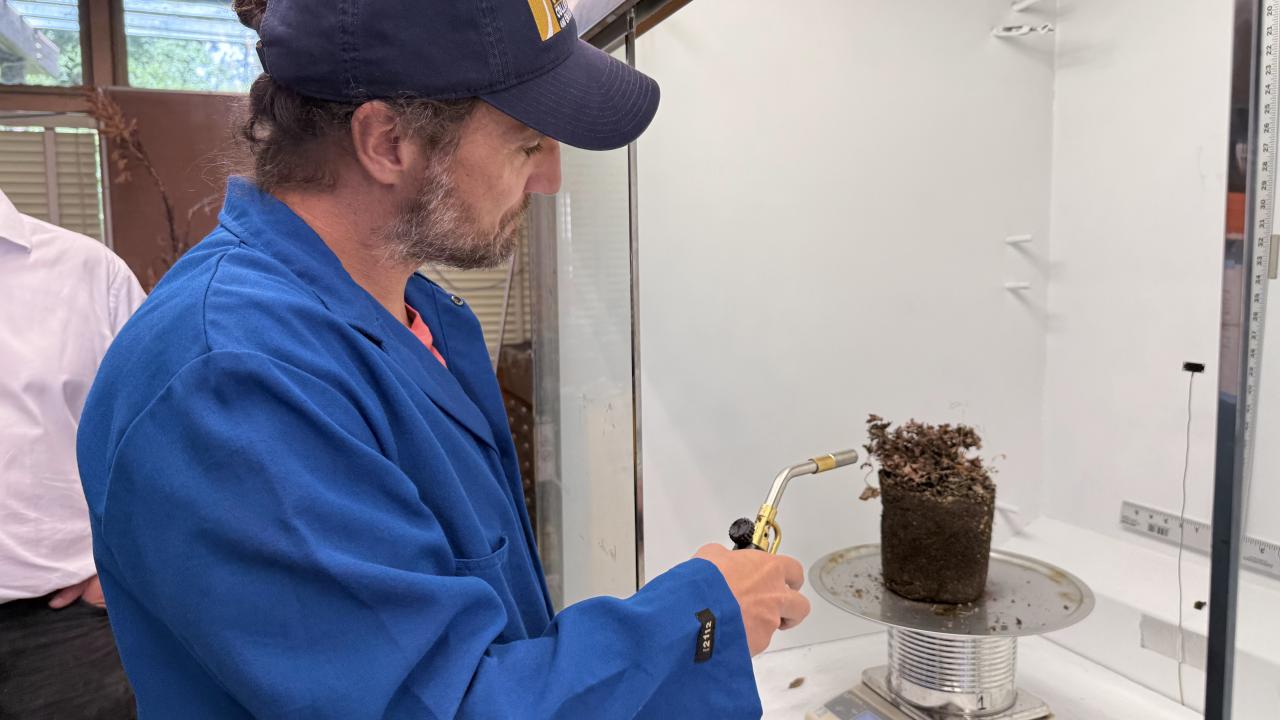
A thin metal plate covered with dead leaves collected from across California erupts into flames, the heat showing on a nearby infrared camera as a vibrant yellow and orange, cooling into red, pink and purple at the edges.
The hottest part is nearly 780 degrees Fahrenheit.
“This is dangerous,” said Alessandro Ossola, an associate professor, as he set a plant ablaze in a protected chamber called a fume hood in his University of California, Davis, lab. “This might well be the difference between saving your life or not. A single tree can make a huge difference.”
Wildfires are increasing in California, and as state regulators and land managers try to make fire-prone areas safer, Ossola is conducting novel research: Collecting leaf litter from among California’s 565 native and exotic urban tree species and measuring how hot they burn or how quickly they flame out.
Balancing benefit and risk
“Our lab is trying to strike a balance between finding the right species that are still providing benefits for people in terms of shade, in terms of cooling and in terms of beauty but also striking a balance with fire risk,” Ossola said.
The work is especially important as California works to meet a goal to increase urban tree cover by 2035.
Media Resources
Alessandro Ossola, UC Davis Plant Sciences, aossola@ucdavis.edu
Kat Kerlin, UC Davis News and Media Relations, 530-750-9195, kekerlin@ucdavis.edu