

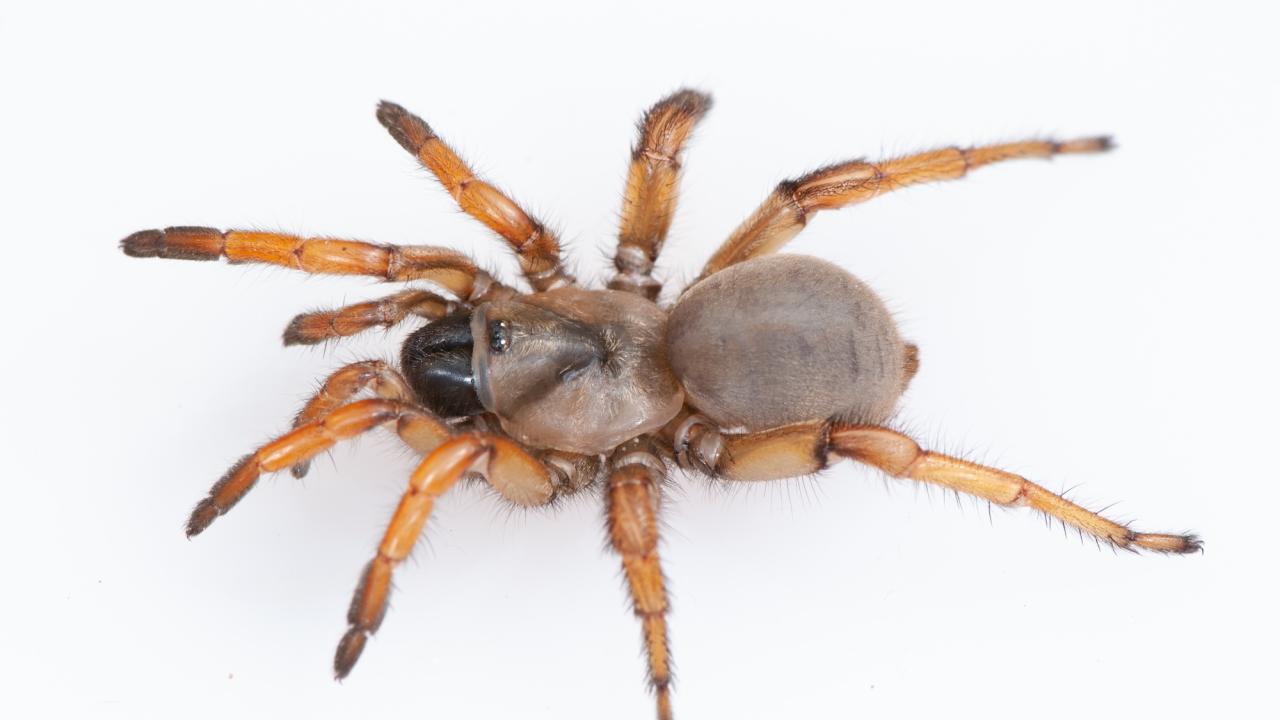
Many spiders reach their maximum size about this time of year, having spent the summer eating, which helps explain their starring role in Halloween decorations. Researchers at the University of California, Davis, have found one particular trapdoor spider, Aptostichus stephencolberti, which is about the size of a quarter, is big in another way: It has an outsized genome.
Given comedian Stephen Colbert’s pompous pundit persona in the former Comedy Central show “The Colbert Report,” it seems fitting that a spider named for him would have a genome roughly 50% larger than the human genome.
“At 4.6 gigabases, or 4.6 billion DNA base pairs, it’s not the largest genome among the spiders, but it’s significant,” said corresponding author Jason Bond, a professor in the UC Davis Department of Entomology and Nematology. Bond said the spider is the first member of its family to have its genome sequenced. The study was published in the Journal of Heredity.
Where it lurks
Hiding in burrows along Northern California’s coastal dunes, beachgoers often, and unknowingly, come into contact with Colbert’s spider namesake. While it lacks Colbert’s developed sense of irony, the trapdoor spider has a flawless sense of timing. Females spend their entire lives underground in silk-lined burrows sealed by a hinged, camouflaged door. They wait for vibrations, emerging quickly to catch prey that wander too close. Its venom is not dangerous to humans. Of the more than 50,000 known spider species, only 30 to 50 have venom known to be toxic to people, Bond said.
Its genome
The spider’s genome is also complex with 52 chromosomes compared to 23 in humans. Much of that size, 77%, comes from repetitive sequences, copied many times throughout the genome, rather than additional genes. All spiders, including this one, lack telomere repeats — the protection for the ends of chromosomes. This loss may explain the faster rate of chromosome evolution in spiders than we see in vertebrates.
“It lends itself to broadening our understanding of spider genome composition and consequently how genomes have evolved across the animal Tree of Life,” Bond said.
Why Stephen Colbert?
In 2008, Colbert learned that Bond had named a trapdoor spider after rock musician Neil Young and developed a bit of spider envy. He used his segment, “Who’s Not Honoring Me Now?” on “The Colbert Report” to demand a spider be named after him. Bond obliged.
At risk of losing their homes if we lose our beaches
The genomic research is part of the California Conservation Genomics project, a state-funded initiative to produce a genomic dataset for conservation science.
Because trapdoor spiders rarely travel far and their coastal dune habitat is fragmented, genomic data can help researchers identify distinct populations that may warrant protection.
“We Californians love our beaches and trapdoor spiders share them with us,” Bond said. “We’re hoping to understand how things like climate change, fire and urbanization might be impacting the genetic diversity of species.”
Aptostichus stephencolberti (the “t” in Colbert is silent) live only in coastal dunes in Central California, from the San Francisco Bay to Monterey. Rising sea levels threaten this narrow habitat.
“They’re going to be incredibly sensitive to sea-level rise, but they’re also very sensitive to invasive species,” Bond said.
Untapped treasure
Spider genomes like this one might also help researchers discover compounds in venom that might have medical or agricultural applications. Some venom-derived compounds have potential as painkillers, while others may help control pests, Bond said.
“We don’t really know what’s out there in terms of untapped natural product diversity for venoms,” he said.
Other authors include Stephen Richards, Emma Jochim, Lacie Newton, James Starrett, Ruta Sahasrabudhe and Oanh Nguyen of UC Davis; Eric Beraut, Colin Fairbairn, Samuel Sacco, William Seligmann and Merly Escalona of UC Santa Cruz; Robert D. Cooper of Virginia Polytechnic Institute and State University; and H. Bradley Shaffer and Erin Toffelmier of UCLA.
This research was supported by the California Conservation Genomics Project, with funding provided to the University of California by the state of California, State Budget Act of 2019 and by the National Science Foundation.
Media Resources
Photo available for download, with credit.
Media Contacts:
- Jason Bond, Department of Entomology and Nematology, jbond@ucdavis.edu
- Amy Quinton, News and Media Relations, amquinton@ucdavis.edu 530-601-8077