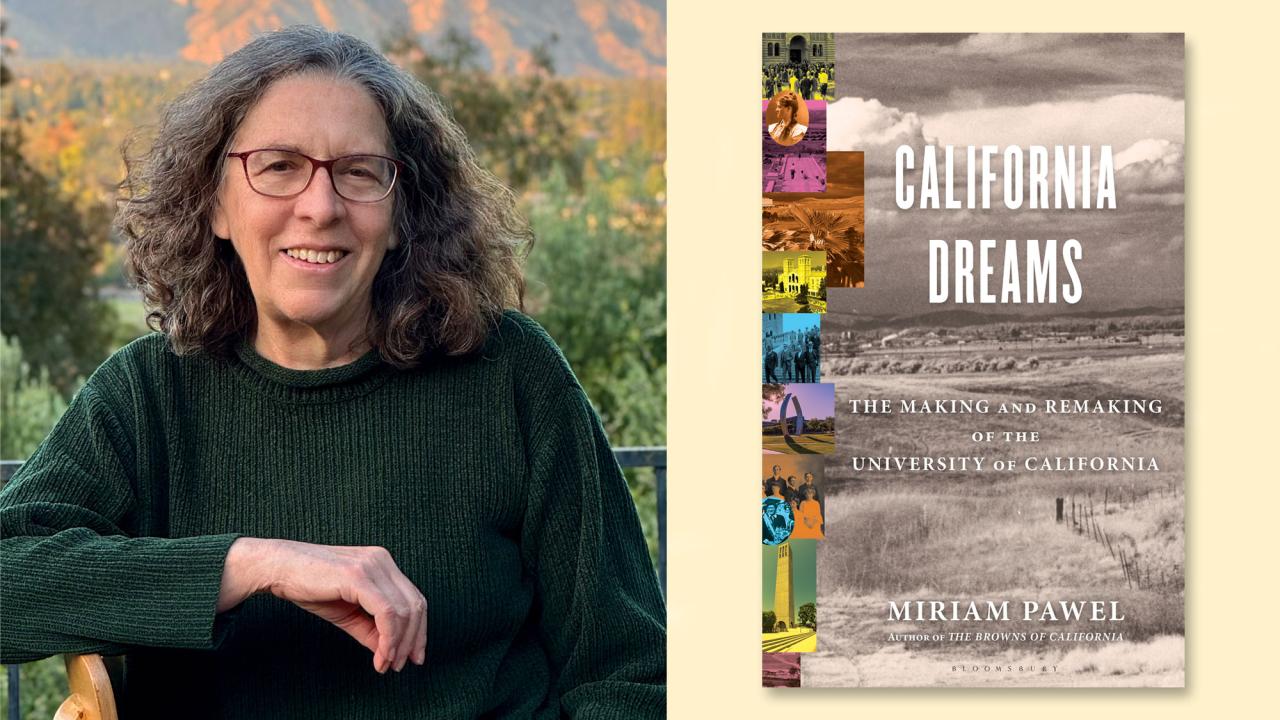
Journalist and author Miriam Pawel tackles the sweeping story of the University of California for her next book, California Dreams: The Making and Remaking of the University of California (Bloomsbury, 2026). The book comes out on Sept. 29.
A New York native who arrived in California in 2000, Pawel spent 25 years at Newsday and the Los Angeles Times and has penned several books on California history and notable Californians.
“The whole system of public higher education in California fascinated and impressed me because it’s so different from the rest of the country,” Pawel said. “I was always very intrigued by that as a newcomer to California.”
In 2020, Pawel was awarded a fellowship at the Radcliffe Institute for Advanced Study, which allowed her to research and write about income inequality in California.
“That led me to focusing on higher education as a factor in upward mobility and in leveling out some disparities,” she said. “And I came back to the idea that the very foundation of the University of California system is that commitment to being a place where working people could get a first-class education.”
Pawel delved into campus library collections, oral histories and other resources to spotlight the evolution of the UC system and its societal impact.
Why did you call the book California Dreams?
Titles for my book have always been in a struggle. And, actually, I would have called this book “Fiat Lux,” but it was never going to work because people don't know what that is. I think that it is so much about the strength of the university, the resilience of it, and the hope that it represents is about people’s dreams. So it works both as a noun and a verb. It represents the best of California or California’s best idea of itself. California dreams big and in principle has been committed to the idea that you can marry excellence with access. That you don’t have to sacrifice one to get the other — that’s a dream. And then the other part of it is the dreams that it has fulfilled for people. That, to me, is the most captivating part of the story. I really wanted to be able to show the difference that the university has made in the lives of people who were not born into privilege.
You also tell the story through the lives of the five graduates, including UC Davis alum David Mas Masumoto. How did you decide to tell the story that way, and how did you choose the people?
I tell stories with people; that's how I write. I got the idea to try to figure out people who were pioneers in different eras and could tell that story. David Masumoto is fairly well known in certain circles, but not as much as Clark Kerr, who is sort of the standout figure there. But he’s a central character to shaping the university to this day and such an interesting person too. I wanted to reflect different parts of the state and different types of people who went to the university and who were changed by it. I wanted people who each had a personal arc, which made writing it somewhat of a challenge, because it was the overall history of the university, the history of California and then the history of each of these people. I had to figure out how to weave all that together.
What is the overarching theme as far as the impact of the University of California?
What makes the University of California different is a commitment to access, which it’s fulfilled in different ways and to different degrees, but it has always maintained that commitment and the commitment to reflect California. That comes up in different times, starting with Daniel Coit Gilman, and that quote gets repeated in very recent years, that this is a university for the people of California. And then in legislation when the regents adopt as a policy the idea that the student body should reflect the demographics of California. How you achieve that and that struggle has its ups and downs, but still fundamentally, there is a commitment there and also a commitment to the idea that trying to be more equitable in the access does not require lowering standards. For me, thematically, that is what makes it a compelling story. It makes it so important.
When you started writing the book, did you know that higher education would become such a big part of the current political discourse?
I had really no idea because in 2021 there was not any reason to think we’re going to be where we are right now. So it was it was kind of odd to be finishing it at a time when there were so many echoes of the past and again. I view this as an ultimately hopeful story in the sense that the university has been through a lot and has been resilient, and I'm sure it will come through this again. But it is very hard to see so much of what it has stood for being under attack.
This interview was edited and condensed.