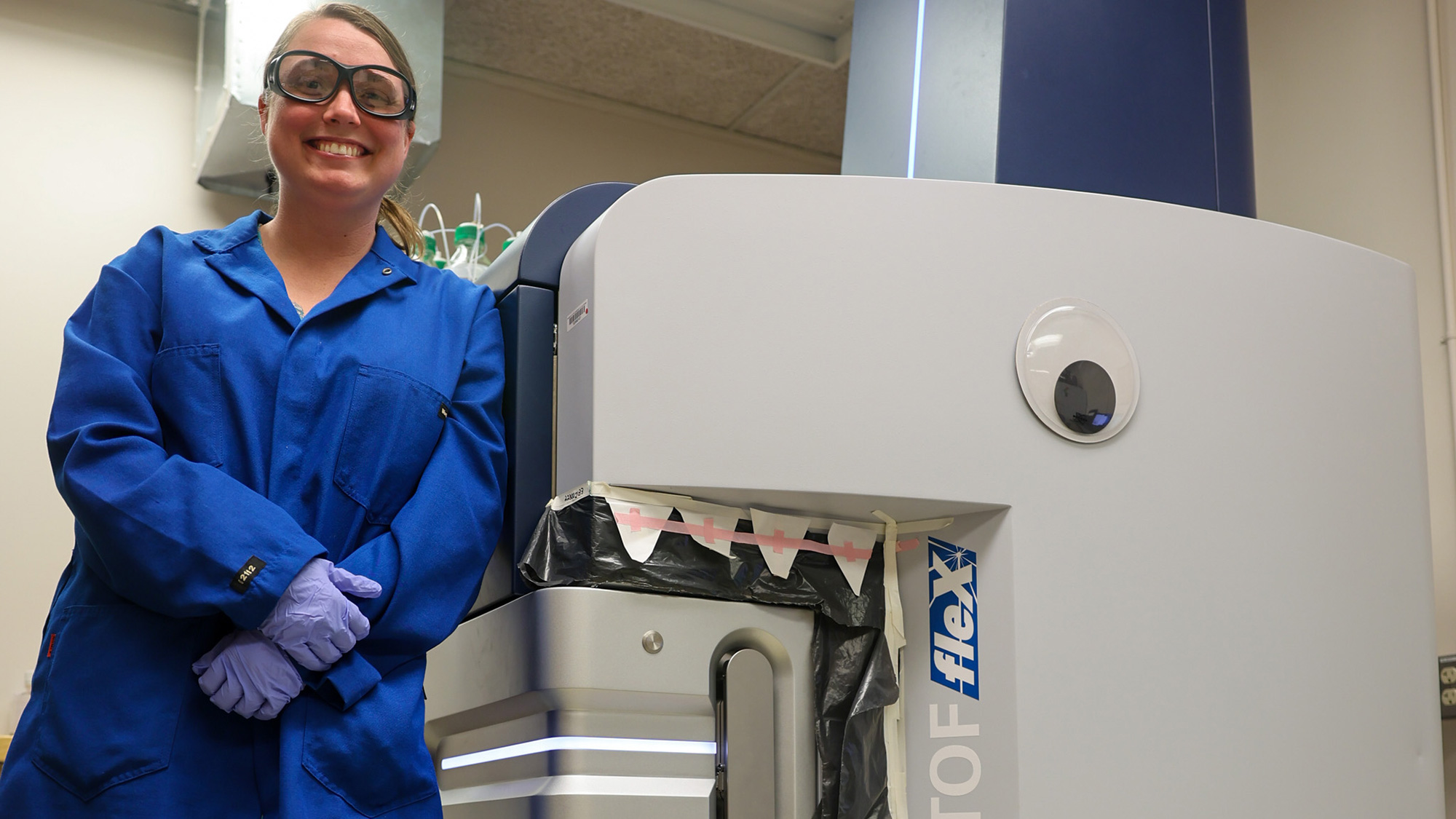
Elizabeth Neumann knew something was wrong. For months, she had been experiencing pain along the side of her lower abdomen. A persistent cold with seemingly no remedy plagued her and she had unexplainably gained 20 pounds.
When she went for a medical checkup, the doctor focused on obesity as the cause of her ailments.
“He was like, ‘You just hit 30; you gained a bunch of weight,’” said Neumann, an assistant professor in the Department of Chemistry in the College of Letters and Science at UC Davis. “I didn’t think that was it, but I recognized the fastest path forward was to lose weight, so I lost 25 pounds. I lost more than I had gained.”
The process crystallized it for Neumann: Something was definitely wrong. A large, noticeable protrusion pushed up beneath the skin of her lower abdomen.
The doctor’s explanation: asymmetric fat loss. Frustrated, Neumann sought a second opinion only to hear the same thing. The diagnoses didn’t add up, leading her to seek out other ways to get the care she needed.
The challenge of women’s healthcare and misdiagnosis
According to a 2024 survey, women are 66.1% more likely to receive misdiagnoses than men and 65.3% more likely to receive poor quality or unsatisfactory medical care.
“How do you self-advocate in the face of doctors?” Neumann said. “Because I am in medical imaging, I have a Ph.D. and I wasn’t listened to.”
To get the medical treatment she needed, Neumann scheduled an appointment for an intrauterine device, or IUD, placement. Complications arose during the procedure, prompting an ultrasound to be ordered.
The ultrasound was all Neumann wanted in the first place. She recalled the shock on the technician’s face when they saw the results.
“They were like, ‘I’m just a tech. I can’t talk to you about it, but you’re just here for an IUD placement?’”
The next day, a doctor called and informed Neumann that she needed emergency surgery to remove a 15-pound ovarian tumor.
“I taught my first class of the quarter knowing that I’d need another faculty member to replace me,” Neumann said.
Using mass spectrometry to study ovarian cancer
Thankfully, Neumann’s surgery was successful. She eventually returned to teaching and research, but the ordeal she went through to obtain a proper diagnosis partly inspired a new research project for her lab.
An analytical chemist, Neumann specializes in using advanced mass spectrometry tools to achieve high-precision chemical measurements and high-resolution imaging for the study of biological phenomena, such as cancer and Alzheimer’s disease. By combining various imaging techniques to analyze a single sample, from a single organelle to whole-body systems, the team can “overlay cellular and molecular information to better understand disease.”
Neumann and her colleagues accomplish this by using a powerful mass spectrometer called the Bruker timsTOF flex system, which Neumann helped develop during her postdoc years.
A new approach to early detection of ovarian cancer
In collaboration with Randy Carney, a UC Davis associate professor of biomedical engineering, Neumann is applying her instrument’s analyzation techniques to study ovarian cancer. Specifically, she’s studying nanoparticles known as extracellular vesicles, or EVs. These molecules can range from 30 to 100 nanometers in size.
“A tumor cell ends up spewing all of these EVs and it’s hypothesized that EVs are involved in things like metastasis,” Neumann said. “What we hypothesize is that the chemical constituents of these EVs probably match the host cell that they come from.”
Neumann and her colleagues have found that EVs and their parent tumor cells share certain chemical signatures.
“What we’re trying to understand is, can we use this to actually do early diagnostics as well as organ tracing of where a tumor might occur?” she said. “We’re trying to make a blood-based test that you can do without the need of an ultrasound.”
Why advocacy matters in women’s health
Neumann’s experience has inspired her to be vocal on the issues women face when it comes to receiving proper medical care.
“Earlier diagnostics are great, but if they’re not something a woman can pursue by themselves, we’re not solving the problem,” she said. “The problem is that doctors don’t listen to women.”
She discusses these topics with her students and is a proponent of self-advocacy.
“Women shouldn’t be afraid to self-advocate,” she said. “People always don’t want to make a big deal out of nothing, but it’s okay to insist on something even if the result is negative. The negative result is preferred.”
She also urged physicians to practice compassion and empathy with their patients. Neumann recalled that the first surgeon she consulted for her procedure recommended removing both of her ovaries in a cavalier way. Neumann, who wants to one day start a family, didn’t think the topic was handled with care.
As with her diagnosis experience, Neumann sought another opinion. The surgeon she eventually selected only had to remove one ovary.
“She tested my other ovary and it was healthy,” Neumann said. “She was wonderful.”