
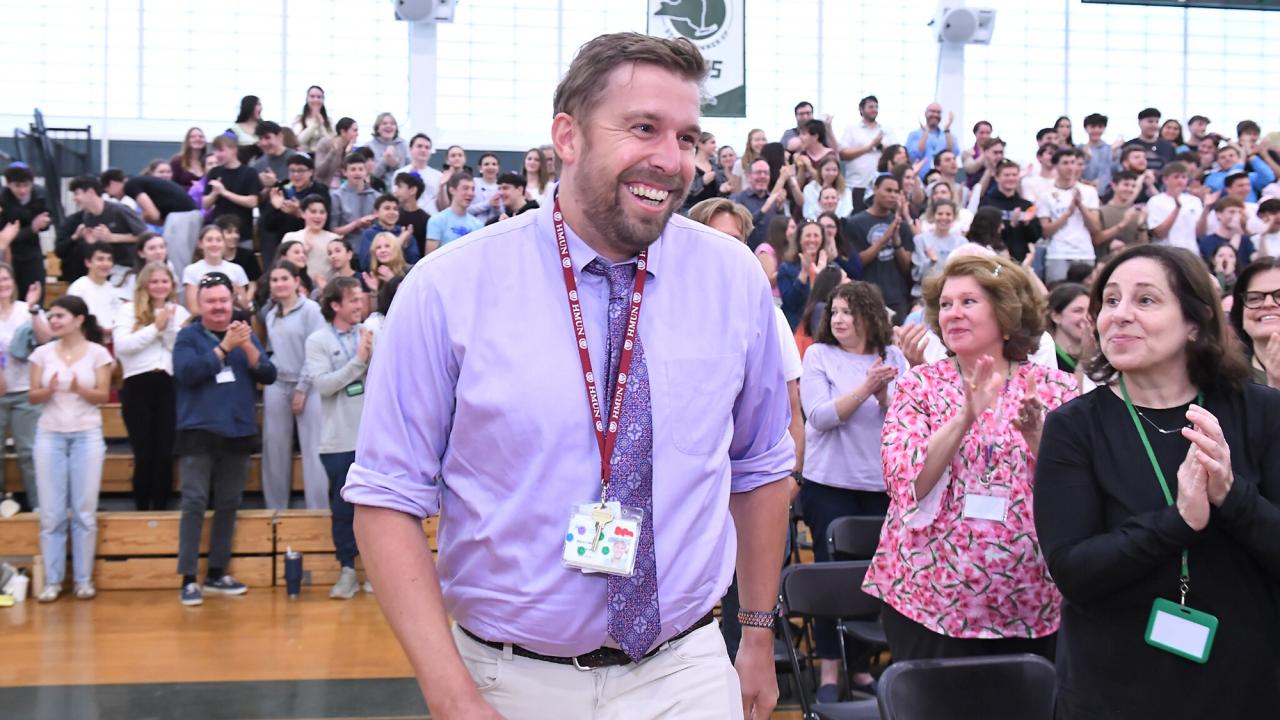
Harry Shontz ’12, a high school social studies teacher, is a stickler for dress-down Fridays. His colleagues at the The Leffell School in Hartsdale, New York, know this about him, and so does the school principal.
When he grudgingly agreed to wear a button-down shirt and tie to work on a Friday in April, he never imagined that a cheering crowd of students, colleagues, honored guests and reporters would be there and that he would be called to the stage for a special announcement.
Shontz, who majored in history and psychology at UC Davis, received a 2025-26 Milken Educator Award, one of 27 given this year nationwide. The award, one of the most highly regarded honors for K-12 teachers, recognizes overall excellence and includes $25,000 he can use for any purpose.
“I’m constantly pushing the boundaries of what I do in the classroom,” said Shontz. “I think the strongest memory from that day is the moment he called my name. I saw every decision flash before my eyes, and it validated every choice I had made in the classroom.”
Finding a mentor in history
Shontz knew he wanted to be a teacher as early as the second grade. He babysat when he was growing up and when he got a little older graduated to summer camp counselor and then swimming coach. He still coaches swimming today.
“I feel like everything I’ve done in my life has set me up for education,” he said.
He didn’t know what specifically he wanted to teach when he first arrived at UC Davis. Then, in his first year, he met the late Katie Harris, a professor who taught early modern European history.
He walked right into her office to ask about her course, which he quickly remembers even now, “Palace Plaza and Privy: Social-Cultural Spaces in Early Modern Europe.”
It was an upper-division course, but Shontz decided to enroll. Almost immediately, his memories from high school of an orderly, chronological recounting of events sunk beneath the vibrance of the spaces in which people actually lived and that defined their lives, from the pub to the marketplace.
“She was everything I needed in a mentor,” said Shontz.
Shontz would go onto take eight classes with Harris, including the quarter she mentored him on his senior thesis. His original thesis topic was 1572 St. Bartholemew’s Day massacre in France, but she had a surprise waiting.
One day in her office, where Shontz had become a fixture, she slammed a book down on the desk and said, “Babies with eyes on their knees.”
In Harris’ class on popular culture in England from the 15th to the 18th century, they had learned about prints with images of babies born with deformities. In those times, a birth defect was interpreted as prophetic.
Shontz would spend his entire senior year researching Mary Toft, an English woman who in the 1720s persuaded the medical community she had truly given birth to 17 rabbits.
Upon graduating, he would go on to graduate coursework in teaching at Manhattanville University before he started his teaching career.
Mastering the minefield of teaching today
Shontz said that teaching social studies is incredibly hard, especially at a time when teachers have been accused of imposing political beliefs on their students. He teaches at a Jewish school where students come from families of all political backgrounds. He is especially mindful of the conflicting beliefs and worldviews students bring with them into the classroom.
“I don't want to teach my students what to think,” he said. “It is my job to teach students how to think critically and how to be civically minded humans in this world,” said Shontz.
Shontz introduced the Reacting to the Past program, originally developed at Barnard College, which he describes as Dungeons & Dragons with historical documents. He was the first social studies teacher at The Leffell School to use this program in the classroom, and today nearly all his colleagues include it.
“I've had 9th graders deeply engaged in heated debates about 16th century dynastic Chinese politics while quoting Confucian analects from memory,” he said.
This approach also helps students to think outside of their own points of view with historical documents representing a wide range of perspectives from people who lived during those times. Students debate from the perspectives of people who might be very different from they are, politically and socially.
“It’s important to showcase to them that you can have these kinds of conversations and get heated, but they can still be civil,” he said.
What makes him most proud, he said, was his ability to deeply connect with students. It’s something he credited directly to his time — and his professors — at UC Davis. After graduating, he stayed in touch regularly with Harris until her passing in 2025.
“No good learning really can occur without some sort of relationship,” said Shontz. “It’s getting to know the students outside of their grades. It’s getting to know the students for who they are. I like to really tie it back to feeling such strong connections with all my high school teachers but especially with professors in the history department when I was at UC Davis.”