

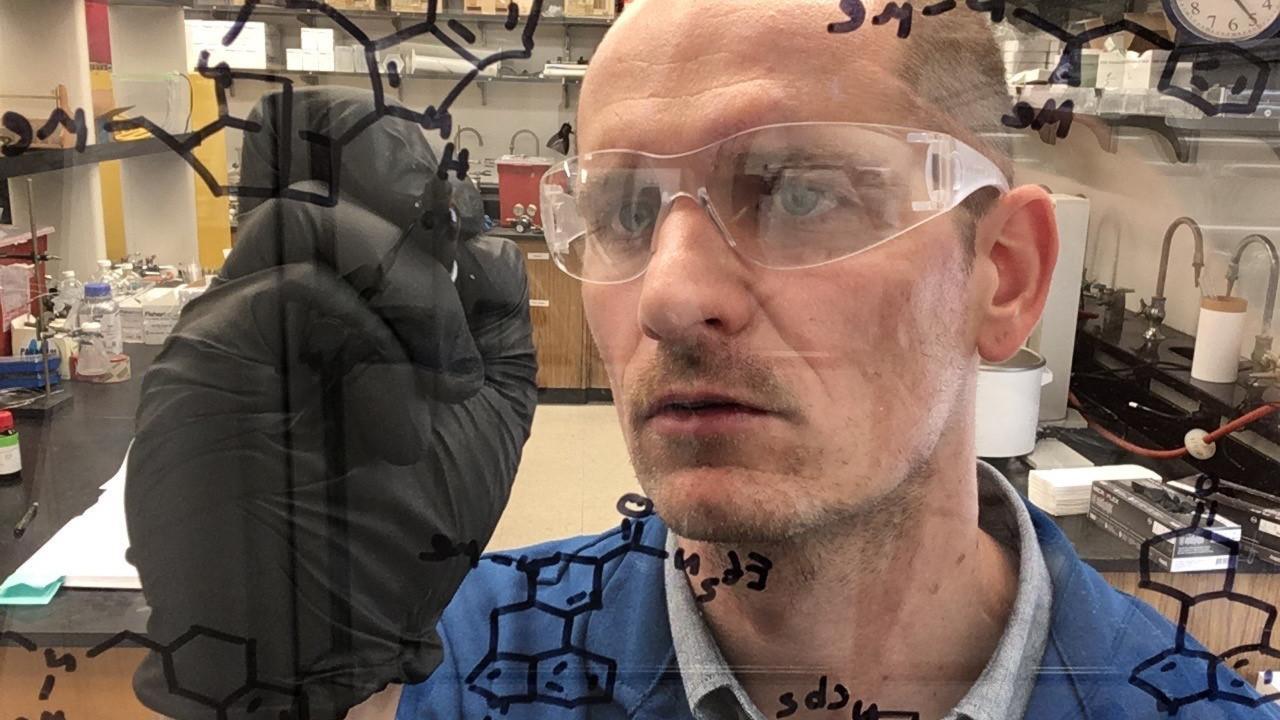
More than 48 million Americans grapple with substance use disorder, according to the Addiction Policy Forum. To help those in need, it’s important to understand the mechanisms underlying substance use disorder. Treating drug addiction starts with understanding the brain.
For his pioneering work in this area, David E. Olson, the director of the UC Davis Institute for Psychedelics and Neurotherapeutics, was recently awarded the Society for Neuroscience Jacob P. Waletzky Award. The award is given to a young scientist whose research has led to significant conceptual and empirical contributions to the understanding of drug addiction.
“This award marks the beginning of a lifelong commitment by our research group to find new solutions for improving mental health,” said Olson, who holds appointment in departments of chemistry, and biochemistry and molecular medicine. “It will take the tireless effort of countless individuals to realize our ultimate goal of improving mental health for those struggling with substance use disorders.”
Neuropsychiatric and neurodegenerative diseases, including drug addiction, are characterized by withering connections between neurons in the brain’s prefrontal cortex. Olson’s research harnesses compounds that can reverse this by inducing neuroplasticity, or the regrowth of these connections.
The Society for Neuroscience honored Olson for his discovery of psychoplastogens, a class of compounds capable of regrowing cortical neurons after a single dose. Olson was the first to demonstrate that psychedelic compounds like LSD, psilocin and ibogaine are effective psychoplastogens. These compounds have demonstrated preclinical and early clinical signs of efficacy for multiple substance use disorders (including opioid and alcohol use disorders) and have the potential to treat co-occurring conditions, such as depression and schizophrenia.
“Olson’s pioneering research serves as a cornerstone of the burgeoning field of chemically induced neuroplasticity and has the potential to substantially change how substance use disorders are treated,” the Society for Neuroscience wrote in its award announcement.
Finalist for Blavatnik National Award
Olson has developed safer, non-hallucinogenic alternatives to psychedelic compounds that set the stage for new, more effective treatments. Delix Therapeutics, a company he co-founded, is scheduled to begin a phase 2 clinical trial of one of these compounds this year.
Olson was also recently named as a finalist for the 2026 Blavatnik National Awards for Young Scientists for this research.
“The use of psychoplastogens for repairing damaged neural circuitry really represents a fundamentally new approach for addressing substance use disorders and related conditions,” Olson said. “The key is going to be making these medicines safe enough so that everyone who needs them will have access to them. The interdisciplinary and incredible team at the Institute for Psychedelics and Neurotherapeutics is putting in the work to make this happen and we are excited for what the future holds.”
Media Resources
Media Contact:
- James Nash, News and Media Relations, 530-219-0943, jnash@ucdavis.edu