

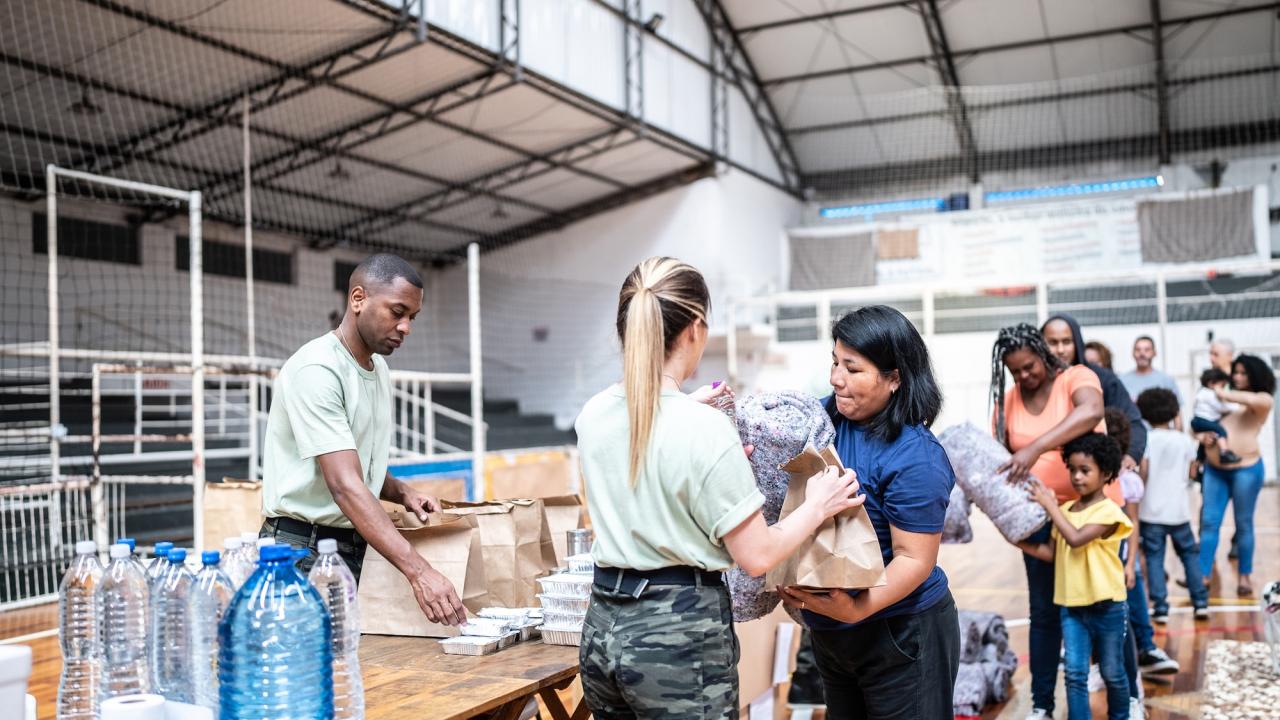
Refugees and asylum seekers, a focus of the recent federal immigration crackdown, have little effect on crime and might even improve local economies for everyone.
These and other findings headline a new National Academy of Sciences report on the economic and social integration of refugees and asylum seekers in the United States. The report recommends that the government focus resources on the first months and years after forced migrants arrive by settling them where workers are needed, supporting their English acquisition and providing them with access to health and education.
“The United States has a long history of providing refuge to people fleeing persecution, violence and war,” said Giovanni Peri, a professor of economics at UC Davis and a co-author of the report. “Concentrating resources on the initial months and years after arrival may be more cost-effective than attempting remedial interventions later on.”
Economic benefits and no effect on crime
The report focuses on the resettlement and integration of forced migrants since 1980, a group made up of people who arrive in the United States as refugees or seeking political asylum.
Peri and the report committee reviewed the latest research and heard from experts in resettlement and local government policy. They conducted their own analyses and compared U.S. policy and outcomes to those in other countries.
The report’s main conclusions:
- Refugees catch up to American-born citizens socioeconomically. Asylum seekers catch up more slowly and on fewer outcomes.
- Forced migrants have small impacts on U.S. labor markets, and their financial impacts on governments vary.
- Refugee resettlement does not affect crime rates.
- Forced migrants’ physical and mental health is often worse than that of other migrants, but many of their conditions are treatable with screening and access to health care.
- In other countries, forced migrants have strengthened labor markets, and being settled in areas with more jobs promotes their integration over time.
Shaping future immigration policy
In addition to early support, the report recommends more stable and predictable asylum laws. While the report was in process in early 2025, the U.S. refugee resettlement program was paused. The Supreme Court has just agreed to hear a case challenging the federal government’s ban on asylum applications at the U.S. southern border.
In June 2026, approximately 2.3 million asylum cases were pending in immigration courts, with an average wait of four years.
Refugees and asylum seekers make up less than 10% of U.S. immigrants admitted since 1980. California is a top state for refugee arrivals. From 2012 to 2022, about 9% of arrivals initially resettled in California. Between 2018 and 2024, 21,000 refugees resettled here, placing the state second only to Texas.
California is also home to 10.9 million immigrants overall, which is more than any other state by far. About 28% of California’s population in 2024 was foreign-born.
Media Resources
Media Contacts:
- Giovanni Peri, Department of Economics, gperi@ucdavis.edu
- Alex Russell, College of Letters and Science, parussell@ucdavis.edu
- Amy Quinton, News an Media Relations, amquinton@ucdavis.edu, 530-601-8077