

Five researchers from the University of California, Davis, were among the recipients of the inaugural awards through the U.S. Department of Energy’s (DOE) Genesis Mission — a national program leveraging artificial intelligence to accelerate breakthroughs in energy, discovery science and national security.
In the announcement, Under Secretary for Science Dr. Darío Gil said: “Through the Genesis Mission, we are bringing together the nation’s leading researchers, institutions, and technology partners to build the next generation of scientific capability. We look forward to seeing these teams demonstrate new research workflows that accelerate discovery and reveal what is possible when AI and science advance together.”
The program received over 5,000 applications and made just 278 awards. The funding will enable the researchers to gain access to the Genesis Mission Platform, including AI agent frameworks, advanced AI models and software. The projects bring together industry partners, collaborators from national laboratories and universities across the country.
The DOE Genesis Mission sparked a major campus-wide effort at UC Davis, with the Office of Research coordinating a dynamic internal selection process that nominated 31 teams to lead proposals and supported investigators in crafting complex and highly competitive applications. In addition, several UC Davis teams pursued the opportunity through collaborations led by national laboratories and corporate partners, reflecting the breadth of expertise and partnership potential across the university.
Selected award recipients
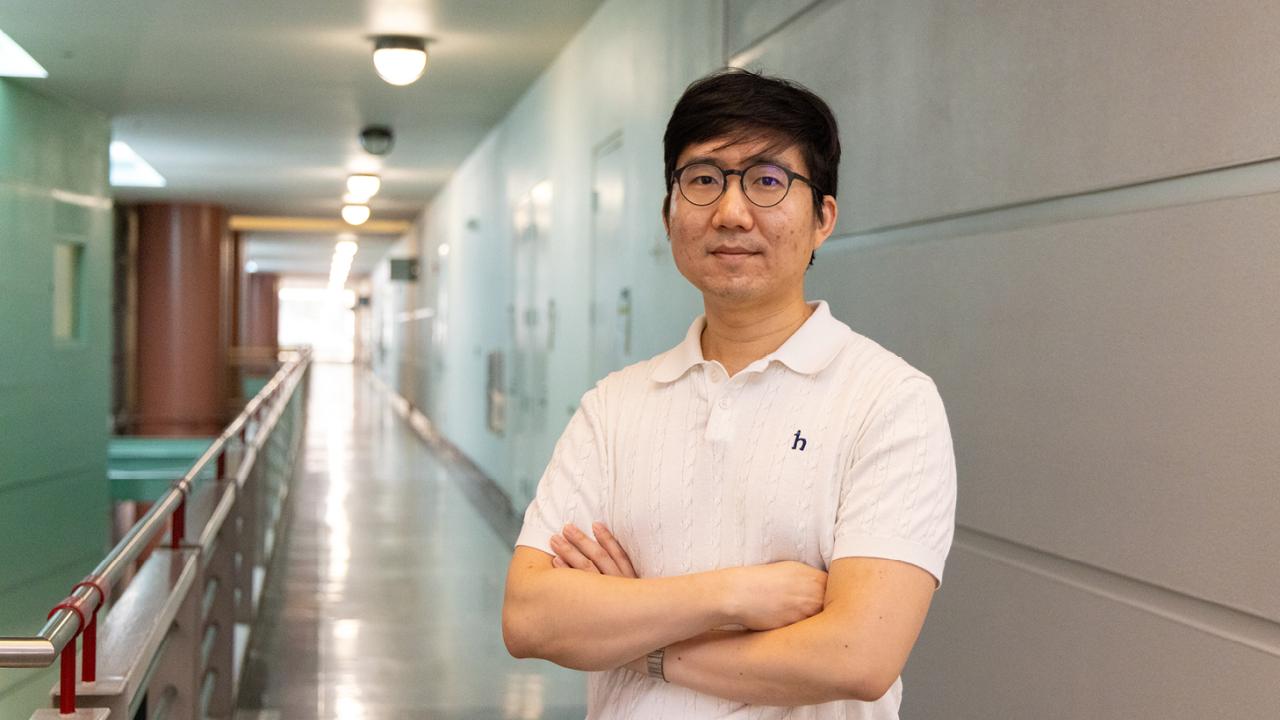
A UC Davis project led by Isaac Kim, associate professor in the Department of Computer Science, aims to accelerate the timeline on which early fault-tolerant quantum computers can be used to address scientific problems beyond the reach of classical computation. The goal is to apply AI to uncover a rotation gadget that outperforms all hand‑designed options, demonstrating AI’s power in quantum algorithm discovery and advancing scientific quantum advantage on early fault‑tolerant quantum computers. Lukasz Cincio at the Los Alamos National Laboratory serves as the co-principal investigator.
Several other UC Davis researchers were selected as subaward recipients partnering with other institutions:
- Daniel Cebra, professor in the Department of Physics, will work with Arts and Science Distinguished Professor of Physics Steffen Bass at the Trinity College of Arts & Sciences at Duke University, and a team that will use AI to link experimental data with simulations of high‑energy heavy‑ion collisions. The researchers seek to deepen understanding of atomic nuclei and reveal how atoms are structured, what conditions are like inside stars, and what the early universe looked like.
- James Crutchfield, distinguished professor in the Department of Physics, and Xiaoli Dong, associate professor in the Department of Environmental Science and Policy, will help develop an advanced AI approach for coupled surface–groundwater modeling that integrates multiple data sources, works across regions, is rigorously evaluated and is demonstrated in energy and flood‐resilience applications. The awarded project is led by EnviTrace LLC, in collaboration with Oak Ridge National Laboratory and Lawrence Berkeley National Laboratory.
- Mingwei Zhang, assistant professor in the Department of Materials Science and Engineering, will serve as co-principal investigator for a project to dramatically enhance both strength and ductility of structural materials for extreme environments such as energy, aerospace and nuclear systems. This project team proposes a closed-loop, AI-accelerated framework to design, synthesize and characterize oxygen-containing complex concentrated alloys. The project is led by Stephanie Ribet, along with co-PI Andrew Minor from the Lawrence Berkeley National Laboratory with co-PIs Brandon Bocklund and Aurélien Perron from the Lawrence Livermore National Laboratory.
Media Resources
Media Contacts
- AJ Cheline, Office of Research, acheline@ucdavis.edu
- James Nash, News and Media Relations, 530-219-0943, jnash@ucdavis.edu